
Dubai climate responsive architecture – Heat as the First Architect
In Dubai, heat is not a seasonal inconvenience. It is the constant condition around which life is organised. Long before questions of style, density, or aspiration enter the conversation, the built environment is forced to respond to temperature, glare, and exposure that rarely recede.
This has a quiet but profound consequence. Homes in Dubai are shaped less by inherited tradition and more by environmental negotiation. Design decisions that might appear stylistic elsewhere – compact plans, deep balconies, tinted glazing, shaded circulation – emerge here as practical responses to a climate that allows little margin for error.
Unlike temperate cities, where architecture can afford to oscillate between seasons, Dubai builds for permanence. Comfort is not something adjusted twice a year; it is something engineered into every day. The city’s residential form, especially its reliance on vertical living and compact apartments, reflects this reality far more than it reflects market fashion.
This Field Note begins from that premise:
In Dubai, the environment is not a backdrop to housing, but its primary author. Market behaviour, buyer preferences, and even notions of livability often trace their origins back to a more fundamental logic – one shaped by heat that does not leave, light that must be controlled, and an outdoor realm that is negotiated rather than occupied.
Understanding Dubai’s homes, therefore, requires starting not with price or typology, but with climate. Everything else follows.
Climate Before Culture
Why environment precedes lifestyle in Dubai
In most cities, housing begins with culture. Plans echo traditions, social habits shape room hierarchies, and climate enters the discussion later, often as an adjustment. Dubai reverses that order. Here, environment arrives first, setting the limits within which culture, lifestyle, and expression must operate.
Extreme heat, high solar glare, and prolonged humidity are not occasional challenges; they are the everyday conditions. As a result, fundamental design decisions are made early and decisively. Orientation is not an aesthetic preference but a thermal calculation. Window sizes are moderated not for privacy alone, but to manage heat gain. Circulation spaces are compressed, shaded, or internalised to reduce exposure rather than dramatise movement.
This environmental primacy explains why many Dubai homes, across price points, share a surprisingly consistent spatial logic. Whether entry-level or premium, apartments tend to favour inward efficiency over outward sprawl. Living spaces are compact but carefully proportioned. Bedrooms are insulated from direct solar impact. Transitional zones are controlled, often acting as buffers rather than social spillovers.
Lifestyle, in this context, is not ignored. It is deferred. Amenities, finishes, and visual openness are layered onto a framework already shaped by climate constraints. The result is a housing stock that may appear uniform at first glance, but is in fact finely tuned to a set of environmental realities that leave little room for improvisation.
This is why Dubai’s residential architecture often feels pragmatic before it feels expressive. The city does not design homes to celebrate climate; it designs them to survive it comfortably. Culture adapts to that logic over time, finding its place within spaces already disciplined by heat and light.
Understanding this hierarchy matters. It explains why certain housing forms persist despite changing tastes, and why others struggle to scale. In Dubai, the most resilient residential models are not those that promise lifestyle first, but those that quietly respect the environment they sit within.
Compactness as Climate Intelligence
Why smaller homes make environmental sense in Dubai
Compact living in Dubai is often explained through affordability or investment logic. Both are valid, but incomplete. Long before compact apartments became a market preference, they emerged as an environmentally rational response to the city’s climate.
In extreme heat, scale works against comfort. Larger homes carry a greater exposed surface area, absorb more solar gain, and demand higher energy input to maintain stable internal conditions. Compact apartments, by contrast, cool faster, retain temperature more efficiently, and reduce the burden placed on mechanical systems. What appears economically efficient is, at a more fundamental level, thermally efficient.
This efficiency shapes layouts in subtle but consistent ways. Rooms are proportioned to minimise dead space. Circulation is tight and purposeful. Walls do more work than they would in cooler climates, acting as buffers against heat rather than mere separators. Even ceiling heights, often assumed to be symbols of luxury, are moderated to balance spatial comfort with energy performance.
Over time, this logic produces a housing stock that rewards optimisation over expansion. Smaller homes are not designed to feel compressed; they are designed to feel contained. The emphasis shifts from how much space is available to how effectively it performs across long, hot days. Comfort becomes a function of enclosure, not openness.
Seen this way, Dubai’s preference for compact apartments is not a market anomaly. It is a form of climatic adaptation. Buyers may articulate their choices in terms of price or yield, but the persistence of these configurations points to a deeper alignment between environmental constraint and spatial efficiency.
Compactness, in Dubai, is not a compromise. It is a calibrated response to a climate that rewards precision and punishes excess.
The Balcony Paradox
Shade, depth, and the illusion of openness
Balconies are among the most recognisable features of Dubai’s residential buildings. They are also among the most misunderstood.
In many cities, balconies are conceived as extensions of daily life. They host meals, conversations, and long periods of occupation. In Dubai, their role is quieter and more technical. Balconies exist less to be used constantly and more to mediate the relationship between inside and outside.
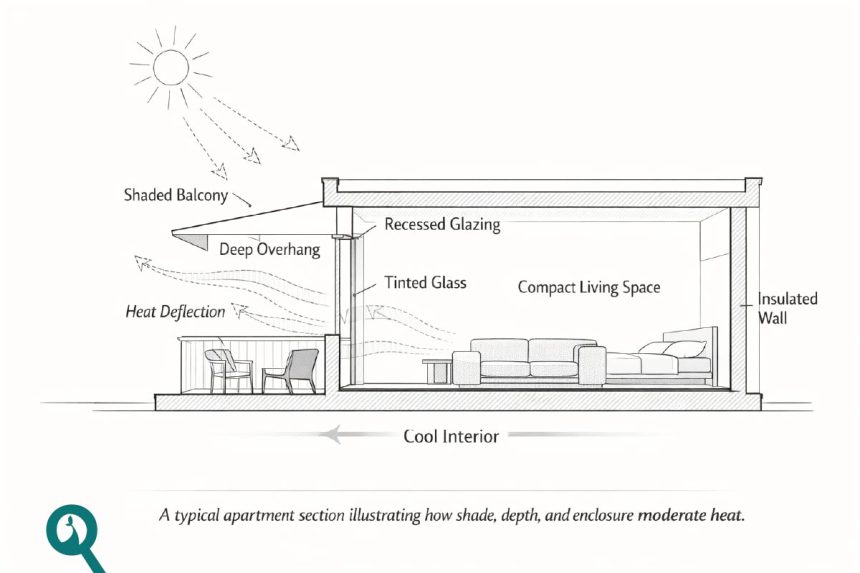
The depth of a typical Dubai balcony is rarely accidental. Deep projections, recessed edges, and side walls are deliberate responses to sun angles and glare. These elements create shade not just for the balcony itself, but for the interior spaces behind it. Living rooms benefit from reduced direct solar exposure, while glazing remains visually open without being thermally exposed.
This creates a paradox. From the inside, balconies suggest openness, light, and a connection to the outdoors. From an environmental standpoint, they function as buffers. They absorb heat, slow down solar penetration, and allow windows to remain usable throughout the day. Their success is measured not by how often they are occupied, but by how effectively they protect the spaces within.
This explains why many balconies in Dubai appear underused when judged by lifestyle metrics alone. Their primary contribution is environmental, not social. They allow apartments to feel generous without paying the energy penalty that fully exposed glazing would impose.
Developers and designers who understand this treat balconies with restraint. They prioritise depth over width, shading over transparency, and continuity over spectacle. Where balconies are flattened or reduced to token gestures, interiors often compensate with heavier mechanical cooling, undermining both comfort and efficiency.
The balcony paradox captures a broader truth about Dubai’s residential design. Elements that appear expressive on the surface are often performing invisible work beneath. What looks like lifestyle is frequently climate management in disguise.
Understanding this shifts how we read the city’s buildings. The success of a balcony in Dubai is not defined by furniture or frequency of use, but by how quietly it makes interior life possible in an environment that is otherwise relentless.
Glass, Light, and Control
Why Dubai’s glazing is more cautious than it looks
Dubai is often described as a city of glass. From a distance, its towers appear transparent and reflective, reinforcing an image of visual abundance. At a closer scale, however, the story is more restrained. Glass in Dubai is rarely about exposure; it is about management.
In a climate where sunlight is intense and persistent, glazing becomes a technical decision before it becomes an expressive one. The size, placement, and treatment of windows are calibrated to admit light without surrendering comfort. What appears generous from the outside is frequently moderated by recesses, shading, and filtration that shape how interiors behave through the day.
Recessed windows are a common response. By setting glazing back from the façade line, buildings reduce direct solar impact while preserving outward views. Tinted or treated glass further filters heat and glare, allowing interiors to remain usable without forcing occupants to retreat behind curtains. This is why many Dubai apartments feel bright but rarely harsh, even during peak summer months.
Orientation sharpens this logic. East- and west-facing exposures are handled with greater caution, often through narrower openings, deeper shading elements, or reduced glazing ratios. North-facing windows, where available, are more generous, benefiting from softer light with lower thermal penalty. These decisions are not stylistic preferences; they are responses to the sun’s predictable path and intensity.
The result is a residential architecture that values light without excess. Unlike cities where glass is used to dissolve boundaries, Dubai uses glass to negotiate them. Transparency is allowed, but always within limits shaped by climate. When those limits are ignored, interiors quickly become dependent on heavier mechanical intervention.
This restraint in glazing helps explain why Dubai homes often feel inwardly calm despite their outward sheen. The façade may shimmer, but the interior remains stable and legible across long daylight hours. Comfort is preserved not by rejecting light, but by shaping how it enters.
Mechanical Comfort vs Passive Wisdom
Where systems end and design begins
In Dubai, mechanical cooling is unavoidable. Any honest reading of residential life in the city must acknowledge this reality. Mechanical cooling is not a luxury here; it is basic infrastructure. Yet the quality of housing is often revealed not by how powerful these systems are, but by how much they are asked to compensate for design decisions made earlier.
Buildings that perform well in Dubai do not rely on mechanical systems alone. They use design to reduce the load before technology intervenes. Compact plans, shaded façades, recessed glazing, and buffered circulation spaces all contribute to stabilising indoor conditions. When these elements are present, air-conditioning supports comfort rather than dominating it.
Where passive measures are weak, comfort is maintained through force. Interiors reach target temperatures, but often at the cost of higher energy consumption, uneven cooling, and constant adjustment. Spaces may feel cold without feeling calm. The distinction is subtle, but noticeable over time.
Passive intelligence also appears in less obvious places. Lift lobbies and corridors are frequently enclosed or lightly conditioned, reducing thermal shock as residents move through the building. Core placements limit heat penetration into living areas. Service zones and circulation spaces act as buffers, protecting primary rooms from direct exposure. These choices do not eliminate the need for air-conditioning, but they make its operation steadier and less intensive.
The most livable homes in Dubai tend to be those where mechanical comfort feels almost invisible. Residents are not negotiating hot and cold pockets or constantly managing settings. Instead, interiors maintain a consistent baseline that allows daily life to unfold without friction. This is the outcome of design that works with climate rather than attempting to overpower it.
As conversations around efficiency and sustainability mature in the region, this balance becomes increasingly relevant. Technology will continue to evolve, but design remains the first line of response. In a climate as demanding as Dubai’s, systems perform best when they are supported by spatial intelligence rather than asked to override environmental reality.
Density Without Exposure
Why vertical living works in extreme climates
Density in Dubai is often discussed in terms of skyline, land value, or urban ambition. Less frequently is it understood as a climatic strategy. In an environment where heat dominates the outdoor experience, vertical living offers a way to concentrate activity while limiting exposure.
High-rise residential buildings reduce the amount of time residents spend navigating open, sun-exposed spaces. Movement from parking to lift, from lift to home, is largely internalised. Shared circulation replaces individual exposure. Compared to low-rise sprawl, where every journey involves crossing open ground, towers compress daily movement into shaded or conditioned zones. This is not simply convenience; it is environmental efficiency.
Vertical density also allows buildings to share thermal loads. Stacked units benefit from mutual insulation, reducing heat gain on exposed surfaces. Roofs and ground planes, which receive the greatest solar impact, are distributed across fewer dwellings. The result is a more balanced thermal profile than what dispersed housing can achieve in the same climate.
This helps explain why apartments perform reliably across Dubai’s residential market, while large-format housing struggles to scale without significant energy input. Villas, particularly those with extensive glazing and detached footprints, are spatially generous but thermally demanding. Their reliance on mechanical cooling is higher, their exposure unavoidable, and their performance heavily dependent on constant system operation.
Towers, by contrast, create a form of protected density. Shaded podiums, internal corridors, and vertical cores form a network of controlled environments. Outdoor spaces are curated and episodic, designed for specific times of day rather than continuous use. Life unfolds indoors by necessity, and vertical living supports that pattern more efficiently than horizontal spread.
This is not an argument against villas or low-rise housing. It is an observation about fit. In extreme climates, density becomes a tool for comfort rather than congestion. When executed well, vertical living in Dubai is less about stacking people and more about reducing the friction between daily life and environmental stress.
Seen through this lens, Dubai’s preference for apartment living is not merely a response to land economics or investment cycles. It is a climatic adaptation that allows the city to function comfortably at scale, even as temperatures push the limits of outdoor habitation.
When Markets Echo the Environment
Transaction data often appears financial on the surface. Yet markets are rarely shaped by finance alone. Over time, they absorb environmental logic long before they articulate it.
Dubai’s sustained preference for compact apartments, vertically organised communities, and buffered residential layouts is frequently explained through affordability, investment cycles, or developer supply patterns. All of these matter. But beneath them sits something more fundamental: fit.
Homes that are easier to cool, simpler to maintain, and more predictable in their comfort naturally sustain demand in a climate where environmental performance is not optional. Buyers may describe their choices in terms of price or yield. The market, however, often filters for environmental efficiency without naming it directly.
This is why certain housing forms persist across cycles. Compact units reduce thermal load. Vertical living limits exposure. Deep balconies and controlled glazing stabilise interiors before systems intervene. These traits are not trends. They are adaptations.
When liquidity concentrates around apartments that respect heat, manage exposure, and operate efficiently, it reflects more than financial logic. It reflects environmental alignment.
Over time, this alignment shapes the city’s residential identity. Architecture adapts to climate. Markets reward what performs. Behaviour follows what works.
In Dubai, the environment is not simply a design constraint. It is a long-term market force. The homes that endure are not those that resist heat, but those that negotiate with it quietly and consistently.
That quiet negotiation is where architecture, climate, and demand converge, and where Dubai’s residential logic continues to take shape.