

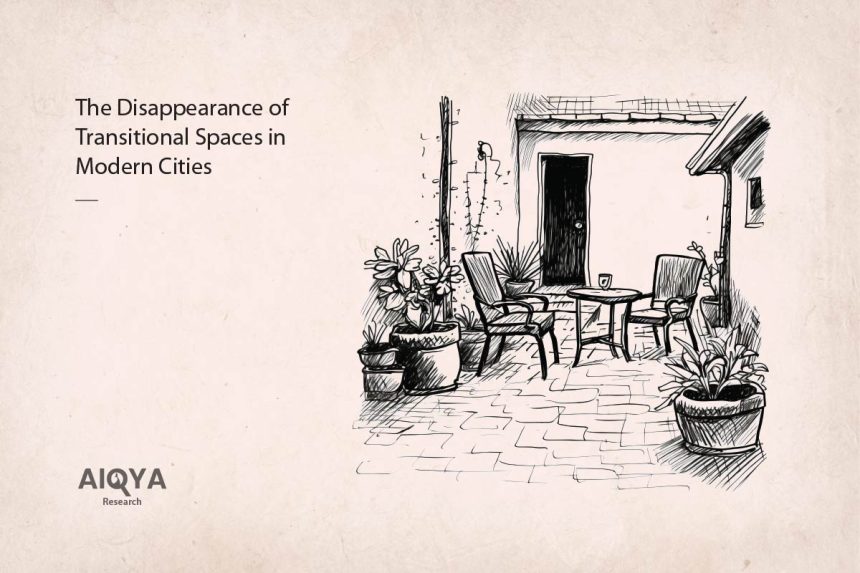
The Disappearance of Transitional Spaces explores how verandahs, courtyards, chabutras, and other in-between environments once shaped everyday urban life, and why their gradual disappearance continues to affect how we experience modern cities.
These spaces regulate more than circulation. They regulate atmosphere.
The Disappearance of Transitional Spaces
There was a time when many environments were designed not simply as enclosed destinations, but as sequences of gradual transition.
One rarely moved directly from street to interior in a single, abrupt step. There were verandahs before living rooms. Shaded sit-outs before entrances. Semi-open corridors that carried breeze and conversation between homes. Courtyards that softened the movement between built structures. Stair landings where people paused briefly rather than passing through mechanically. Even older streets often contained thresholds of varying scales, shaded edges, spillover spaces, tree cover, raised platforms, low compound walls, and subtle environmental layers that slowed movement and softened social interaction.
These spaces were rarely treated as amenities.
They were simply understood as part of inhabiting.
Over time, many of these transitional environments quietly began disappearing from contemporary urban life.
In many modern developments today, movement has become increasingly compressed and optimized. Basements connect directly to elevators. Corridors are minimized for efficiency. Climate-controlled interiors reduce the need for semi-open environmental buffers. Shared thresholds become narrower, faster, and more transactional. What once functioned as spaces of gradual psychological adjustment are increasingly replaced by direct transitions between isolated environments.
The loss may appear minor architecturally, yet its effects are felt constantly in the rhythm of daily life.
Transitional spaces do something subtle to human experience. They prepare the mind before arrival. They soften the shift between public and private, movement and stillness, indoors and outdoors. A shaded verandah allows the body to slow down after heat and noise. A semi-open corridor carries air, light, and traces of everyday life between neighbours. A courtyard creates a pause without explicitly demanding it.
These spaces regulate more than circulation.
They regulate the atmosphere.
Perhaps this is why environments with meaningful transitional layers often feel psychologically calmer even when their residents may not consciously analyze why. The experience of movement becomes less abrupt. One is allowed to arrive gradually rather than instantly.
I began thinking about this more carefully while observing how contemporary urban environments increasingly prioritize efficiency over environmental rhythm. In many cities today, movement is optimized around speed, security, enclosure, and climate separation. While these shifts solve practical concerns, they also reshape how people psychologically experience space.
A basement elevator lobby may function efficiently, yet it often removes the small environmental transitions that once connected people more gently to their surroundings. Air-conditioned circulation systems may improve thermal consistency, but they can also flatten sensory variation across environments. Long sealed corridors reduce exposure to breeze, changing light, ambient sound, and the subtle environmental cues that make spaces feel alive rather than mechanically repeated.
The result is not necessarily discomfort.
More often, it is sensory compression.
Many contemporary environments now move people from one controlled interior to another with very little environmental decompression in between. Street to lift. Lift to the corridor. Corridor to the apartment. Office to parking. Parking to roadway. Over time, the city begins feeling less like a sequence of inhabited environments and more like a system of enclosed transitions optimized primarily for movement efficiency.
And yet, some of the most memorable environments continue to rely heavily on transitional space.
A shaded passageway where light shifts gradually through the day. A verandah where conversations extend into the evening. A semi-open staircase carrying traces of rain and breeze during monsoon months. A courtyard edge where children pause instinctively while moving through the community. These spaces rarely dominate brochures or architectural photography, yet they often become the environments most deeply woven into everyday memory.
In many older Deccani neighbourhoods, the chabutra outside the house often functioned as a small transitional world of its own. Neither fully inside nor entirely part of the street, it created space for pause, conversation, observation, and informal social life. People gathered there during evenings, children moved around it instinctively while playing, neighbours paused briefly while passing through. Architecturally modest, these edges subtly softened the boundary between private life and the city outside.
People rarely experience cities only through destinations. They experience them through transitions.
Even within many contemporary apartment buildings in Hyderabad today, one still notices traces of this threshold behaviour surviving in compressed form. The small seating edges and shoe-rack zones outside apartment entrances often become informal pause spaces of their own — places where people briefly sit while wearing footwear, exchange passing conversations with neighbours, or leave small traces of domestic life extending slightly beyond the front door. Architecturally modest, they continue performing a transitional role even within far more compressed residential environments.
Part of what makes transitional spaces important is that they support forms of interaction and awareness that cannot be fully programmed. They allow lingering without instruction. They create opportunities for accidental encounters, visual familiarity, environmental pause, and small moments of observation that more compressed environments often eliminate.
In many traditional settlements, thresholds also functioned climatically. Deep overhangs reduced heat gain. Verandahs moderated sunlight. Semi-open edges improved ventilation. Courtyards created airflow and diffused light. The environmental logic and social logic of these spaces were often deeply interconnected.
Today, many contemporary projects continue borrowing the visual language of openness while reducing the actual spatial depth of transition itself. A decorative sit-out replaces a usable verandah. A narrow balcony substitutes for environmental engagement. Landscapes become visually present but psychologically distant from everyday circulation and inhabitation.
The issue is not nostalgia.
Cities evolve. Lifestyles change. Density introduces real constraints.
But perhaps the deeper question is whether modern environments have become so optimized around efficiency, privacy, and controlled interiors that they increasingly struggle to create softer rhythms of inhabitation.
Because people rarely experience cities only through destinations.
They experience them through transitions.
Through the gradual shift between light and shade.
Noise and silence.
Movement and pause.
Exposure and enclosure.
And as contemporary urban life becomes faster, denser, and more psychologically overstimulating, these in-between environments may become more important than ever.
Not because they are traditional.
But because they continue performing something deeply human:
they allow people to arrive slowly into space, into the atmosphere, and sometimes even into themselves.