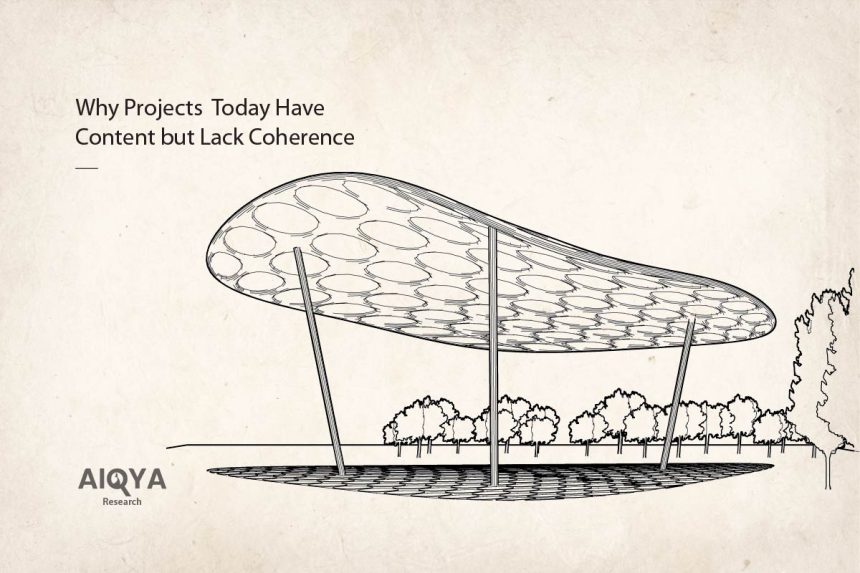
Why Projects Today Have Content but Lack Coherence examines how modern housing environments increasingly rely on spectacle, branding, and visual communication while struggling to create lasting spatial identity, emotional continuity, and meaningful environmental experience.
Projects increasingly share similar wellness vocabulary, cinematic launch films, façade language, and amenity imagery despite being positioned as entirely distinct environments.
Why Projects Today Have Content but Lack Coherence
Contemporary real estate projects are communicated more extensively than ever before. Long before a building is completed, it already exists across teaser films, websites, brochures, CGI walkthroughs, social media campaigns, drone videos, hoardings, sales galleries, and carefully staged experience centres. Entire project worlds are often constructed before people physically inhabit the environments themselves.
And yet, despite this abundance of communication, many projects remain strangely difficult to remember. Across many urban corridors today, projects increasingly share similar wellness vocabulary, cinematic launch films, façade language, and amenity imagery despite being positioned as entirely distinct environments.
Not because they lack ambition, investment, or visual polish, but because the different layers of the project often fail to speak the same language.
Architecture moves in one direction. Marketing adopts another vocabulary entirely. Landscape becomes decorative rather than experiential. Wellness turns into a catalogue of amenities. Sustainability becomes an interchangeable terminology repeated across projects regardless of context. Over time, what may have begun as a distinct idea slowly fragments into disconnected parts.
I began noticing this gap more clearly while observing how certain environments leave behind unusually strong emotional recall despite having far less visual noise. In those places, the experience feels coherent across multiple levels. The architecture, materials, movement, landscape, transitions, communication, and even the emotional tone of the environment seem to emerge from a shared line of thinking.
That coherence is difficult to manufacture superficially because people often sense it instinctively before they fully articulate it.
A courtyard feels meaningful not only because it exists physically, but because the larger environment around it supports slowness, gathering, pause, and continuity. A landscaped pathway feels restorative not simply because trees were added afterward, but because movement, shade, rhythm, and openness were considered part of the experience from the beginning.
The strongest environments are rarely built from isolated features alone. They emerge from continuity of thought across multiple layers of the project.
The challenge is no longer the production of content itself. It is whether all of that content genuinely belongs to the same project world.
In many projects today, communication is treated as something layered onto the project after the core design decisions have already been made. Architecture is completed first. Marketing language arrives later. Visual identity is developed separately again. Each discipline may function well independently, yet somewhere in between, the project as a whole begins losing clarity.
The result is not necessarily poor communication. In fact, much of it can appear highly sophisticated on the surface. The renderings are cinematic. The copy is polished. The amenities are extensive. But despite the effort, many projects struggle to develop a lasting emotional identity because their various layers are not reinforcing the same underlying idea.
This fragmentation becomes even more visible in an era shaped increasingly by AI-generated imagery, accelerated content cycles, and interchangeable design language. Today, almost every project can produce compelling visuals, articulate wellness narratives, or borrow the vocabulary of sustainability and luxury. The challenge is no longer the production of content itself. It is whether all of that content genuinely belongs to the same project world.
I have often found that the environments people remember most deeply are usually the ones where this continuity feels natural rather than manufactured. The experience extends quietly across scales. A material palette aligns with the atmosphere of the landscape. Transitional spaces support the emotional rhythm suggested by the architecture. The language used in communication reflects the actual feeling of inhabiting the environment rather than simply describing aspirational lifestyles.
These relationships are often subtle, yet they shape perception far more deeply than isolated visual gestures.
A project may speak about calm while creating relentlessly overstimulating environments. Another may describe community while offering few spaces that genuinely encourage informal interaction. Some projects adopt the vocabulary of nature while treating the landscape merely as a decorative foreground around towers. The disconnect may not always be immediately visible, but over time, people begin sensing when environments and narratives are not fully aligned. In some cases, the environmental narrative appears strongest inside the brochure long before it becomes spatially visible on the ground.
What makes certain environments feel distinct, then, is not necessarily the scale of their amenities or the novelty of their communication. More often, it is the presence of a coherent underlying philosophy capable of extending quietly across architecture, landscape, movement, materiality, and experience without constantly announcing itself.
Coherence often reveals itself not through spectacle, but through consistency.
This does not mean every project requires a grand conceptual narrative. In many cases, coherence emerges through smaller decisions repeated consistently over time. The way pathways naturally slow movement. The relationship between built form and open space. The emotional tone is created through light, texture, proportion, and rhythm. The continuity between how a project is described and how it is eventually inhabited.
Some of the most meaningful forms of coherence are almost invisible when viewed individually. A shaded threshold that softens the transition between indoors and outdoors. A landscape designed not only for visual effect but for lingering and pause. A naming system that emerges from the atmosphere of the environment rather than generic luxury vocabulary. Even subtle experiential gestures can begin reinforcing a larger emotional identity when they emerge from a shared line of thinking.
Perhaps this is why environments that feel deeply coherent often remain difficult to imitate convincingly. Their strength rarely comes from isolated artifacts or aesthetic formulas. It comes from continuity, from the sense that multiple layers of the environment were shaped with awareness of one another rather than assembled independently.
In many ways, the future challenge for architecture and communication may not simply be producing more content, but creating environments capable of sustaining meaning across increasingly fragmented forms of attention and consumption.
Because people rarely remember places only for what they offered.
More often, they remember how consistently an environment made them feel over time. In a market increasingly saturated with imagery, coherence itself may become one of the rarest forms of distinction.
Continue Reading
- What Lockdown Taught Us About Space
- Architecture in the Age of Fragmented Attention
- Why Projects Today Have Content but Lack Coherence