
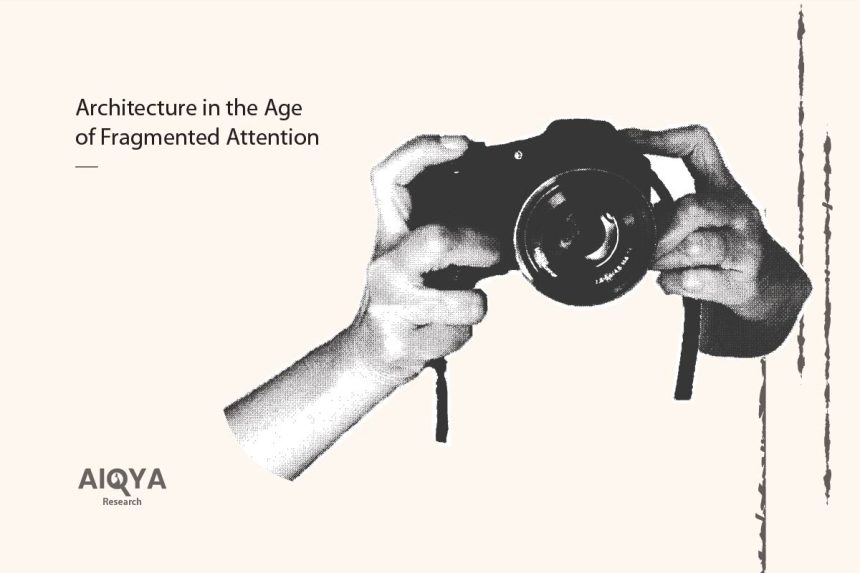
Architecture in the Age of Fragmented Attention explores how modern cities, digital overstimulation, and fragmented attention are reshaping the way people experience architecture, movement, memory, and environmental presence in everyday urban life.
We photograph before observing. Record before listening. Share before absorbing.”
Architecture in the Age of Fragmented Attention
A few months ago, while visiting a museum, I noticed something that felt quietly revealing about the way we experience the world today. In front of a large painting, several people had their phones raised, carefully framing photographs of the artwork on their screens. Some zoomed in. Others recorded short videos before quickly moving on to the next frame. Very few stood still long enough to simply observe the work itself.
What stayed with me afterward was not the question of technology or social media. It was the realization that many contemporary experiences are now mediated before they are fully inhabited.
Fragmented attention is no longer only a technological condition. It is becoming a spatial condition as well.
We photograph before observing. Record before listening. Share before absorbing.
The shift is subtle, but it changes the texture of attention itself.
I began thinking about how deeply this condition extends into the environments we inhabit daily. Cities today compete constantly for human attention. Notifications, advertisements, traffic, screens, background audio, and endless streams of information shape the rhythm of contemporary urban life almost continuously. Even moments of rest are often consumed through another layer of stimulation.
In such an environment, uninterrupted presence has quietly become rare.
And perhaps that is why certain spaces continue affecting us differently. Not necessarily because they are visually dramatic, but because they momentarily interrupt the fragmentation of attention. A shaded courtyard that softens noise. A walking trail beneath tree cover. Filtered light inside a quiet library. Rain against a semi-open sit-out. These environments do not demand attention aggressively. They hold it gently.
Somewhere along the way, I began thinking less about architecture as a collection of objects and more about its ability to shape states of mind. Why do certain places allow people to slow down almost instinctively? Why do some environments encourage lingering while others are experienced only as surfaces to move through quickly?
The idea of “State of Flow” emerged from similar questions. Not as a slogan or amenity-driven concept, but as an attempt to understand what kinds of environments still allow immersion in an age increasingly defined by interruption.
Modern environments are often designed to maximize stimulation. Retail spaces compete for visibility. Digital platforms compete for retention. Even residential projects increasingly rely on spectacle to establish distinction. Towers become taller, lighting becomes brighter, imagery more cinematic, and amenities more performative. Yet despite all this amplification, many environments remain strangely forgettable once the initial novelty fades.
I began wondering whether attention behaves differently in spaces that are not constantly trying to capture it.
There is a particular quality to environments that reveal themselves gradually rather than immediately. Their impact comes less from visual intensity and more from rhythm, proportion, texture, light, silence, and movement. One does not merely look at such spaces. One inhabits them over time.
This distinction feels increasingly important because fragmented attention is no longer only a technological condition. It is becoming a spatial condition as well.
Many contemporary environments are now experienced in fragments. A lobby becomes an Instagram frame. A café becomes a backdrop for remote work. A museum becomes a sequence of images stored in a device rather than an encounter remembered physically. Even homes are often consumed through scrolling galleries long before they are ever inhabited in reality.
And yet, the environments people remember most deeply are rarely the ones optimized only for spectacle.
They are often spaces that create a sense of immersion difficult to explain immediately. A courtyard where conversations stretch longer than intended. A shaded pathway that instinctively slows walking pace. A room where natural light shifts gently through the day. A landscape that absorbs noise instead of competing with it. These experiences may appear subtle, but they affect the nervous system in ways modern urban environments often overlook.
Perhaps this is why ideas around flow continue to matter beyond productivity or performance. At its deepest level, flow may simply be the experience of uninterrupted presence, moments where attention becomes fully absorbed rather than constantly divided.
Architecture cannot eliminate distraction entirely. Cities will continue becoming faster, denser, and more digitally layered. But environments can still create moments of psychological continuity within that acceleration. They can offer spaces where attention is not scattered, but quietly gathered.
What becomes increasingly interesting is that environments capable of holding attention are rarely the ones shouting for it. They tend to work through accumulation rather than instant impact. Through sensory balance rather than overload.
A tree-lined pathway slows the body before the mind fully notices it. A quiet transition between indoors and outdoors creates a subtle psychological shift. Water, shade, filtered light, textured materials, and even the soundscape of a place begin influencing how long people remain present within an environment.
These effects may appear intangible, yet they shape human behavior constantly.
In many contemporary cities, fragmentation is produced not only by screens but also by the environments themselves. Excessive visual clutter, relentless movement, noise, harsh lighting, compressed layouts, and the absence of transitional spaces gradually condition people toward speed rather than absorption. Environments become spaces to move through efficiently rather than places to inhabit meaningfully.
Perhaps this is why walking regained a different kind of importance for many people in recent years. Not walking as optimization or exercise, but walking as cognitive release. During and after the lockdown years, I found myself increasingly drawn toward environments that encouraged unstructured movement; shaded loops within communities, pathways without urgency, streets that allowed lingering rather than simply circulation.
There is a reason many ideas around reflection, creativity, and mental clarity across cultures remain connected to movement through landscapes. Forest trails, cloisters, courtyards, gardens, verandahs, shaded streets; these spaces create conditions where attention begins reorganizing itself more slowly and coherently.
In that sense, architecture is not merely shaping physical experience. It is continuously shaping mental rhythm.
And perhaps one of the quieter responsibilities of contemporary environments is not simply to stimulate people endlessly, but to occasionally protect them from fragmentation itself.
Perhaps this is why the environments that remain meaningful over time are rarely the ones experienced most quickly. They are not always the most photographed, the most dramatic, or the most technologically saturated. More often, they are spaces that quietly allow people to feel more present within themselves.
A courtyard remembered years later for the quality of evening light. A shaded sit-out where conversations extended without noticing time. A pathway walked repeatedly during periods of uncertainty. A room that held silence comfortably. These experiences rarely announce themselves in the moment, yet they continue lingering in memory long after more visually aggressive environments fade away.
Contemporary life increasingly conditions people toward constant partial attention to consume quickly, respond continuously, and move restlessly from one layer of stimulation to another. Within that rhythm, environments capable of slowing perception without forcing it may become increasingly valuable.
Not because they reject modern life, but because they create brief conditions where people can inhabit it more consciously.
The idea of flow, then, is perhaps less about productivity than about continuity of attention. About moments where the mind stops scattering itself across multiple layers of noise and becomes fully absorbed within an experience, a conversation, a landscape, or simply a quiet stretch of space.
Architecture alone cannot create presence. But it can shape the conditions that make presence more possible.
And perhaps that is one of the deeper questions contemporary environments will increasingly need to confront: not only how spaces look, but how they hold attention, memory, and emotional rhythm over time. Because as attention fragments further, environments that can quietly gather it may become increasingly rare.
Continue Reading
- What Lockdown Taught Us About Space
- Architecture in the Age of Fragmented Attention
- Why Projects Today Have Content but Lack Coherence