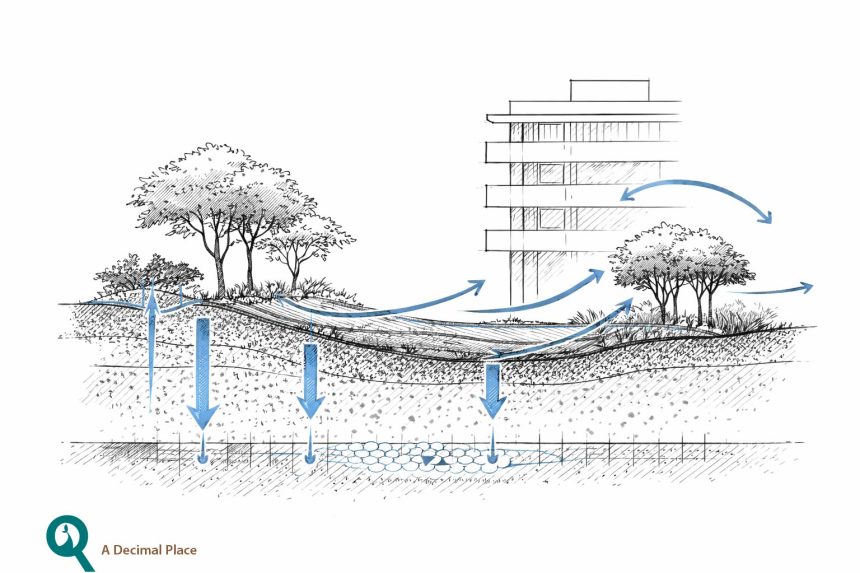
Sustainable Urbanism: Green alone does not define sustainability. True resilience emerges when water, heat, soil, and built form operate as coordinated systems over time.
Green, on its own, is not a system. And systems, unlike symbols, reveal themselves only after use.
Green has become the most reassuring colour in contemporary development. A row of trees, a planted terrace, a vertical garden climbing a facade, all signal care, responsibility, progress. Yet many of the places that look the greenest remain deeply uncomfortable to live in.
This is not a failure of intention, but of definition. Sustainability, when reduced to what can be seen, often ignores what must quietly endure – water movement, heat, soil, maintenance, and time. What looks ecological in the first year can become extractive by the fifth.
Green, on its own, is not a system.
And systems, unlike symbols, reveal themselves only after use.
Sustainability is often described through outcomes rather than processes. Green cover, shaded walkways, landscaped roofs, and tree counts are presented as evidence of ecological intent. While these elements matter, they are only fragments of a much larger system. On their own, they say little about how a place performs over time.
Exclusive Research. Structured Access.
To preserve quality and purpose,
AIQYA’s research is shared by request.