

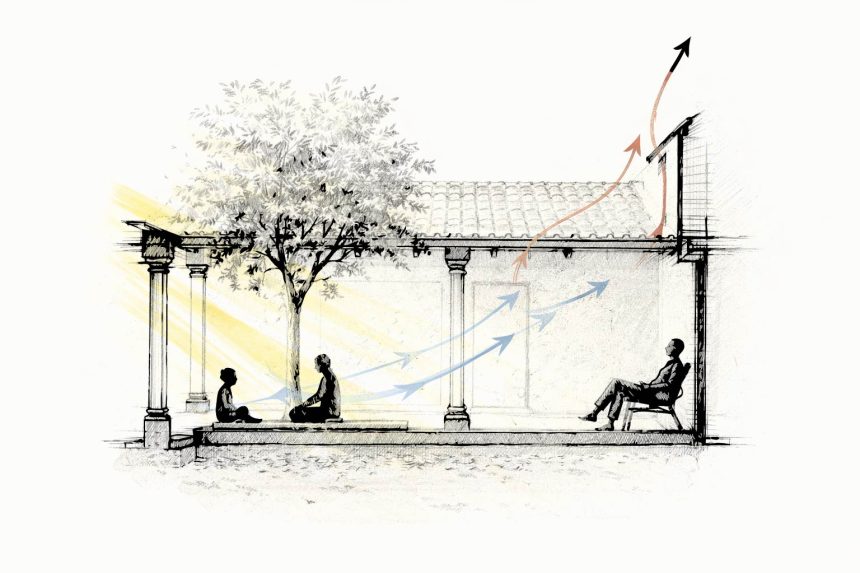
Light, Air, and the Architecture of Ease
A comfortable room rarely announces itself.
It reveals itself slowly – in the way daylight drifts across a wall, in how air moves without asking permission, in the absence of effort it asks of the body.
We tend to credit comfort to finishes, furnishings, or climate control. But long before materials register, the senses respond to something more elemental. Light that arrives at the right angle. Air that circulates without noise. A space that neither presses in nor leaks away.
This is the architecture of ease.
Not a style, not a feature – but a condition created when light and air are allowed to follow their natural rhythms, guided gently rather than constrained.
This is the architecture of ease – not a style or a feature, but a condition shaped by how light and air are allowed to move.
Ease in architecture is often misunderstood as generosity. Larger rooms, taller ceilings, and wider openings are assumed to translate into comfort. Yet many expansive spaces feel strangely demanding, while smaller ones feel calm. The difference lies not in size, but in how light and air are choreographed.
Exclusive Research. Structured Access.
To preserve quality and purpose,
AIQYA’s research is shared by request.