

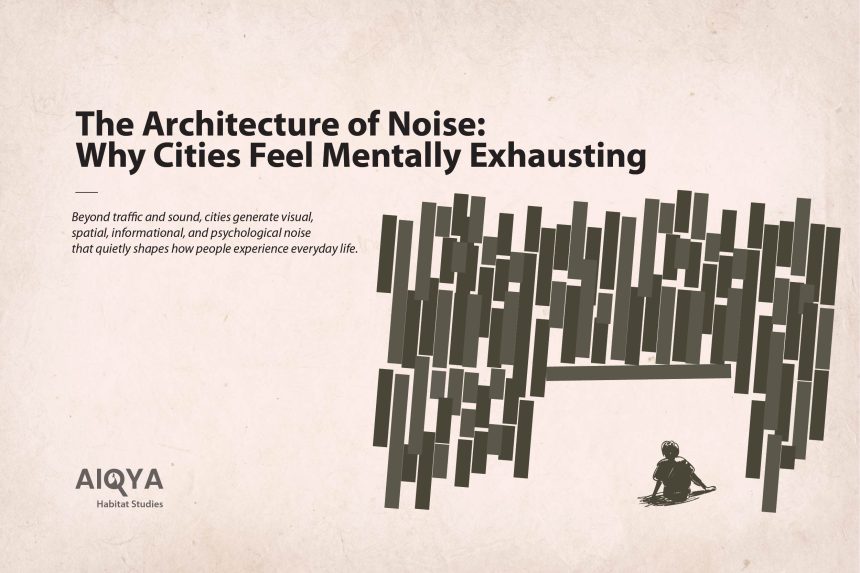
The architecture of noise extends far beyond sound. While traffic, construction, and crowded streets are often blamed for urban stress, modern cities also generate visual, informational, spatial, and psychological noise. These layers of stimulation accumulate throughout the day, shaping how people think, feel, and recover. As urban environments become denser and more connected, understanding the architecture of noise may be essential to understanding why so many cities feel mentally exhausting despite becoming more efficient and technologically advanced.
The architecture of noise is not only about what cities add. It is also about what they remove.
Noise is often understood only as sound.
Traffic. Honking. Construction. Generators. Aircraft. Loud streets. Dense intersections.
But contemporary cities increasingly produce many other forms of noise as well: visual noise, informational noise, spatial noise, and psychological noise. Much of it accumulates gradually until overstimulation begins to feel normal.
One notices it in the visual density of urban corridors. Competing hoardings stacked above roads. LED screens layered across facades. Buildings are illuminated aggressively through the night. Continuous notifications arriving through personal devices, while traffic, advertisements, conversations, alarms, and movement overlap almost simultaneously within the same field of attention.
The modern city rarely stops speaking.
And perhaps that is why environments capable of holding silence, not necessarily literal silence, but sensory relief, increasingly affect people so deeply.
I began thinking about this more carefully while observing how differently certain environments regulate mental fatigue. Some places seem to intensify cognitive pressure almost immediately. Others create an instinctive sense of decompression without people fully understanding why.
The difference often extends beyond acoustics alone.
A narrow street lined with reflective surfaces may feel harsher than a shaded street carrying the same traffic volume. A visually cluttered corridor can feel more exhausting than a quieter environment with comparable movement levels. Harsh lighting, compressed circulation, continuous glare, aggressive signage, repetitive surfaces, and the absence of environmental variation all contribute toward forms of sensory accumulation that cities rarely acknowledge directly.
In many contemporary environments today, stimulation is treated almost as a default condition. Retail districts compete for visibility. Public environments prioritize brightness and movement. Residential projects increasingly rely on spectacle to establish distinction. Large illuminated lobbies, oversized screens, reflective facades, aggressively lit landscapes, and cinematic arrival sequences create immediate visual impact, yet often add very little sensory calm to everyday life.
The issue is not that cities should become silent.
Cities are energetic by nature.
The deeper question is whether environments still contain enough moments of relief between stimulations.
Historically, many settlements contained forms of environmental buffering almost instinctively. Tree-lined streets softened the heat and sound. Courtyards interrupted urban density. Verandahs filtered transitions between indoors and outdoors. Narrow shaded lanes reduced glare. Water bodies cooled the surrounding microclimates. Even older neighbourhoods often carried fluctuating rhythms of compression and release rather than continuous sensory exposure.
Contemporary urban environments increasingly flatten these variations.
Glass, concrete, reflective paving, traffic intensity, dense visual communication, and sealed interiors often create environments where the nervous system remains under near-constant stimulation for long periods of time. Over time, people adapt behaviourally. Headphones become defensive tools. Silence itself begins to feel unfamiliar. Attention fragments more easily. Lingering outdoors becomes psychologically tiring even before it becomes physically uncomfortable.
Perhaps this is also why people increasingly seek environments that feel calmer without always being able to explain what creates that feeling. A shaded pathway beneath mature trees. A quieter internal street where traffic slows naturally. Filtered daylight inside a semi-open corridor. The sound of leaves moving above traffic rather than only the traffic itself. These experiences rarely eliminate noise entirely, yet they alter how environments are physiologically processed.
Perhaps the environments that remain most livable will not be the ones that appear most impressive, but the ones that understand how to create moments of sensory recovery.
The architecture of noise is not only about what cities add.
It is also about what they remove.
Tree canopies disappear.
Threshold spaces shrink.
Walking environments become harsher.
Public seating vanishes.
Transitional edges collapse into traffic infrastructure.
Outdoor environments prioritize movement efficiency over sensory comfort.
And gradually, cities lose many of the softer environmental layers that once absorbed psychological pressure before it accumulated fully.
In many Indian cities today, one can still observe fragments of quieter environmental intelligence surviving almost accidentally. A shaded tea stall beneath dense tree cover where people linger longer than intended. A narrow lane where building shadows soften the afternoon heat. A semi-open corridor carrying breeze between homes. A chabutra edge where conversation slows movement naturally. These spaces are often modest and informal, yet they regulate atmosphere far more effectively than many highly designed urban environments.
What makes such places restorative is rarely luxury.
More often, it is sensory modulation.
The ability of an environment to balance stimulation with pause.
Movement with stillness.
Exposure with shelter.
Density with relief.
Perhaps this is one of the quieter challenges contemporary cities will increasingly need to confront. Not simply how to accommodate more people, vehicles, infrastructure, and digital systems, but how to prevent urban life from becoming psychologically exhausting by default.
Because people do not experience cities only through efficiency or functionality.
They experience them through nervous systems constantly responding to light, sound, temperature, movement, texture, rhythm, compression, and release. And perhaps the environments that remain most livable over time will not necessarily be the ones that appear most visually impressive, but the ones that understand how to create moments of sensory recovery within the accelerating intensity of urban life itself.
You may also like:
The Disappearance of Transitional Spaces in Modern Cities