
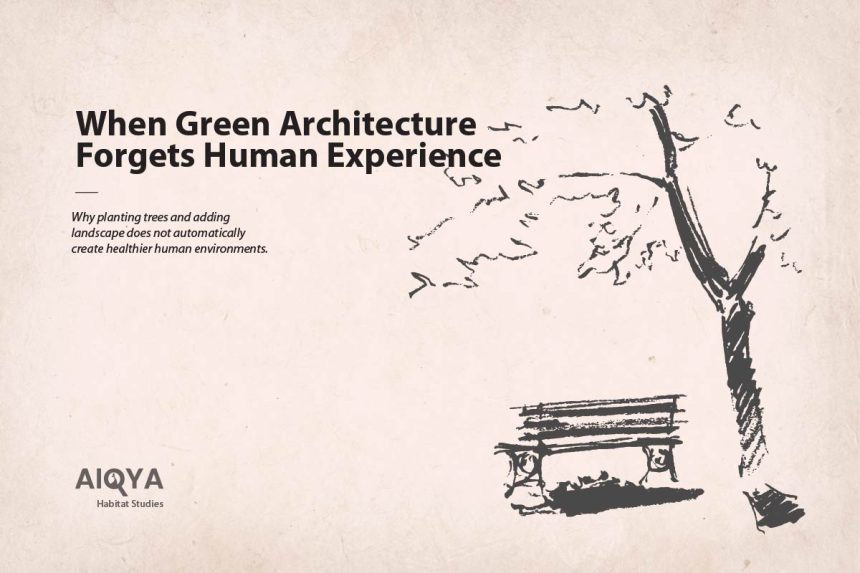
Green is not the same as biophilic. As cities embrace sustainability, many projects increasingly equate landscaping with environmental wellbeing. Yet some of the greenest-looking environments remain thermally uncomfortable, behaviourally underused, and disconnected from everyday human experience. Understanding this distinction may be one of the most important conversations in contemporary architecture and housing.
Nature becomes visible. But not always inhabitable.
Few words have entered contemporary housing vocabulary as quickly as “green,” “wellness,” and “biophilic.” Across brochures, hoardings, launch films, and project websites, nature now appears almost everywhere. Towers rise from heavily landscaped renderings. Vertical gardens frame facades. Wellness decks overlook water features. Tree canopies soften arrival sequences in cinematic twilight imagery.
At first glance, it may appear that cities are finally rediscovering their relationship with nature.
And in some cases, they genuinely are.
But increasingly, one also notices a growing confusion between environments that merely appear green and environments that meaningfully support human and ecological well-being.
The distinction matters more than it first appears.
A project may contain landscaping without being environmentally restorative. It may include plants while still producing excessive heat, glare, noise, and sensory fatigue. It may visually reference nature while remaining fundamentally disconnected from climate, movement, shade, biodiversity, airflow, or the psychological rhythms that shape how people actually experience environments over time.
In many contemporary projects today, greenery functions primarily as visual framing. Trees become compositional devices around towers. Landscapes are optimized for renderings and arrival experiences. Planting appears concentrated near entrances, clubhouses, and marketing viewpoints while large portions of everyday circulation remain thermally exposed and behaviourally underused.
Nature becomes visible.
But not always inhabitable.
Perhaps this is why some heavily landscaped environments still feel strangely exhausting after extended periods of time, while others with far less visual spectacle feel instinctively calming. The difference often lies not in the quantity of greenery, but in how deeply environmental thinking shapes the experience of inhabiting the space itself.
True biophilic environments rarely operate only at the level of aesthetics.
They work through environmental relationships.
Shade that meaningfully alters outdoor usability. Tree cover that changes walking behaviour. Breezes that move naturally through semi-open corridors. Landscapes that absorb heat and soften sound. Transitional spaces that allow gradual shifts between indoors and outdoors. Water that cools the atmosphere rather than functioning only as a decorative foreground.
These environments influence the nervous system continuously, often without people consciously noticing it.
The difference often lies not in the quantity of greenery, but in how deeply environmental thinking shapes the experience of inhabiting the space itself.
I began thinking about this distinction more carefully while observing how frequently contemporary housing communication now uses the language of wellness and biophilia almost interchangeably with landscaping itself. Yet many of the environments described this way remain highly sealed, thermally artificial, visually overstimulating, or behaviourally disconnected from everyday outdoor life.
In some projects, one encounters beautifully rendered landscapes that are rarely inhabited beyond occasional visual appreciation. Lawns remain empty through large portions of the day due to heat exposure.
In many Indian cities, one often notices beautifully landscaped podium gardens remaining largely unused through summer afternoons, while the few shaded edges beneath mature tree cover continue attracting most everyday outdoor activity.
Pathways function more as aesthetic connectors than lived walking environments. Outdoor spaces photograph beautifully while supporting relatively little informal lingering or environmental engagement.
The issue is not whether these landscapes are attractive.
Many of them are.
The deeper question is whether they fundamentally change the environmental experience of everyday life.
Because genuine biophilic thinking extends far beyond planting strategy. It begins shaping orientation, airflow, materiality, light, microclimate, sensory variation, movement, ecological integration, and the psychological relationship between people and their surroundings.
A shaded pathway may contribute more meaningfully to environmental well-being than a visually dramatic lawn exposed to harsh afternoon heat. A semi-open verandah carrying breeze and filtered light may regulate stress more effectively than an ornamental green wall disconnected from inhabitation. Even the soundscape of an environment, birds, rustling leaves, and softened ambient noise, becomes part of how environmental comfort is experienced physiologically over time.
In many traditional settlements, these relationships often emerged naturally through climatic adaptation rather than environmental branding. Courtyards moderated heat. Deep overhangs reduced glare. Tree cover softened streets. Verandahs created thermal and social thresholds between indoors and outdoors. Nature was not treated as a separate layer applied afterward, but as part of how environments functioned fundamentally.
Today, many contemporary developments continue borrowing the visual language of biophilia while compressing its environmental depth.
Greenery becomes surface.
Biophilia becomes imagery.
Wellness becomes vocabulary.
And somewhere in that translation, the relationship between ecology and inhabitation risks becoming increasingly performative.
The issue is not that contemporary projects should reject landscaping aesthetics or environmental branding altogether. Cities genuinely need more ecological thinking. Dense urban environments require shade, biodiversity, permeability, water management, and outdoor comfort more urgently than ever before.
In many climates, native and regionally adapted planting often contributes far more meaningfully to long-term environmental comfort than ornamental greenery selected primarily for visual uniformity. Mature shade trees, seasonal variation, bird activity, and ecologies familiar to the region frequently create environments that feel more alive and behaviourally inhabited over time.
The future challenge may be whether cities can move beyond cosmetic greening toward environments where nature meaningfully shapes how people live, move, recover, gather, and psychologically experience urban life itself.
Because people do not respond to nature only visually.
They respond through temperature.
Through sound.
Through shade.
Through airflow.
Through seasonal change.
Through movement.
Through sensory relief.
And perhaps the environments that remain most restorative over time are not necessarily the ones that appear most green in imagery, but the ones where ecological thinking becomes inseparable from everyday life itself.
More read: