Dubai real estate investment has increasingly become a channel through which global capital is deployed, rather than simply a market that attracts it.
Over the past two decades, transaction patterns, investor behaviour, and development cycles suggest a deeper shift. Capital is not just entering the market during periods of uncertainty. It is being directed toward a system that allows it to move, transact, and reposition with relative ease.
Recent activity reinforces this trend. Record transaction volumes, sustained off-plan demand, and a diverse international buyer base point to a market that is no longer defined by isolated cycles. Instead, Dubai is gradually functioning as a platform where global capital is organised and deployed across multiple segments of the residential market.
Understanding this shift requires looking beyond headline numbers and examining how capital behaves across cycles, how supply is structured, and how the market absorbs demand over time.
Key Observations
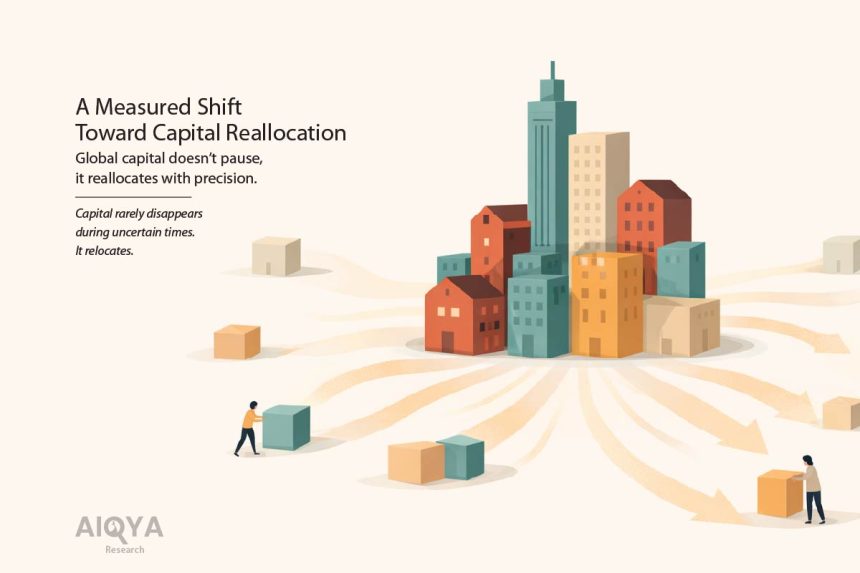
- Global capital does not disappear during periods of uncertainty. It reallocates, and Dubai has increasingly emerged as a destination where these flows are absorbed.
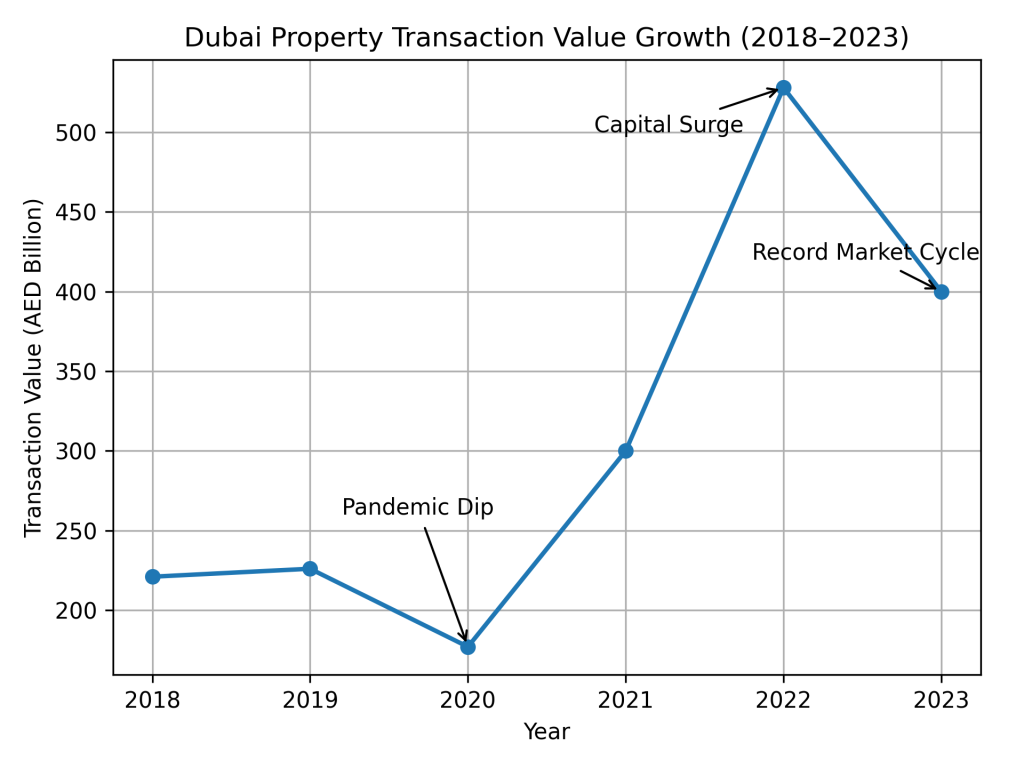
- Dubai recorded 133,000+ transactions in 2023., with transaction values exceeding AED 400 billion, marking the highest level of activity in the market’s history.
- Periods of global disruption, including financial crises, policy shocks, and post-pandemic shifts, have repeatedly coincided with renewed inflows into Dubai’s property market.
- Structural factors such as regulatory clarity, transaction efficiency, and investor accessibility continue to support sustained capital participation.
- Demand is not concentrated within a single segment. Capital enters the market across geographies, buyer profiles, and price bands, contributing to depth and resilience.
- The AED 1 million to AED 2 million segment has emerged as a key liquidity band, supporting a significant share of residential transactions.
Capital Does Not Disappear. It Reallocates.
One of the more consistent patterns in global real estate is that capital rarely disappears during periods of uncertainty. It reallocates, moving gradually toward markets where transactions remain liquid and regulatory systems are predictable. Over time, Dubai has positioned itself as one of the destinations where these flows tend to arrive.
This is not tied to a single event or cycle. Financial disruptions, policy shifts in major economies, and geopolitical tensions have all influenced capital movement across markets. Yet across different periods, the same underlying behaviour appears to repeat. When uncertainty rises elsewhere, investor activity in Dubai’s property market often strengthens.
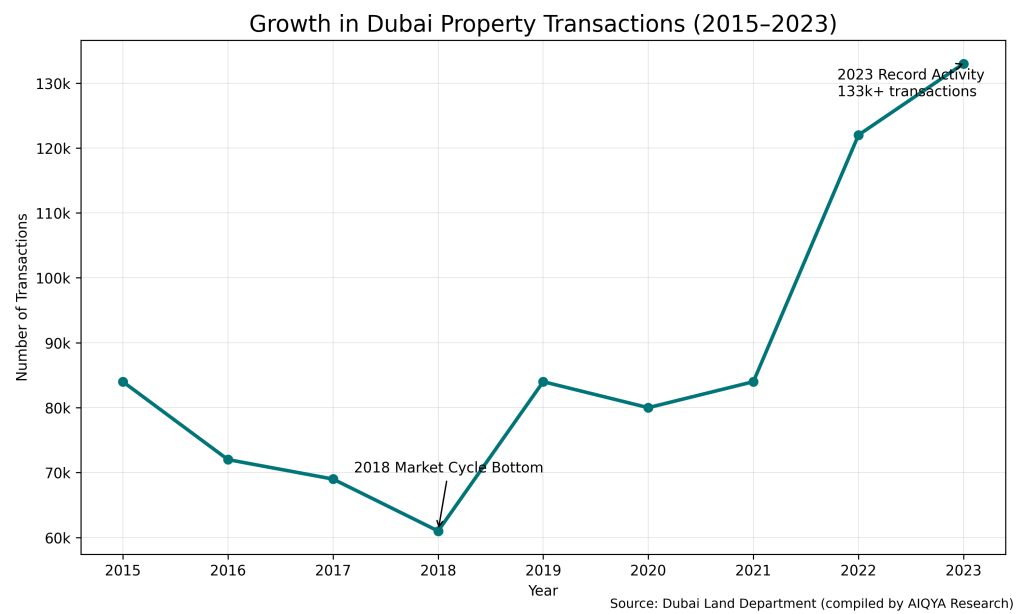
Transaction data provides a useful reference point. According to the Dubai Land Department, the emirate recorded more than 133,000 property transactions in 2023, with total transaction values exceeding AED 400 billion, the highest level of activity in the market’s history. A significant share of this demand came from international buyers, reinforcing Dubai’s position as a market that operates within a global investment context rather than a purely regional one.
What is important here is not just the scale of activity, but the consistency of this pattern over time. Dubai’s real estate market has moved through multiple cycles over the past two decades, each shaped by different external triggers. Yet across these cycles, the direction of capital flow has shown a degree of continuity.
Understanding this behaviour requires looking beyond individual events and examining how global capital responds to uncertainty. That broader pattern provides the foundation for why Dubai continues to attract investor interest today.
AIQYA Insight
Capital inflows into Dubai are not event-driven in isolation. They reflect a broader pattern of reallocation, where investors shift exposure toward markets that offer liquidity, regulatory clarity, and ease of deployment during uncertain periods.
Capital does not disappear. It reallocates toward systems that allow it to move with ease.
How Global Disruptions Redirect Capital into Dubai
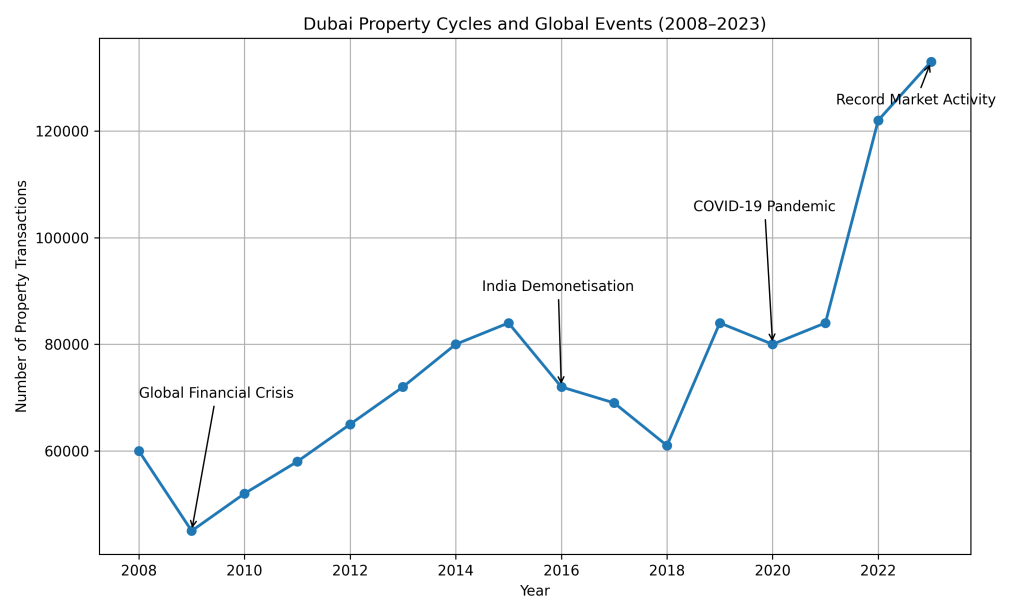
Dubai’s property market has moved through multiple cycles over the past two decades, yet a consistent pattern emerges when these periods are viewed together. Episodes of global disruption often coincide with renewed inflows of international capital into the city’s real estate sector.
The triggers vary, but the direction of capital movement remains consistent.
In the years following the global financial crisis of 2008, Dubai experienced a sharp correction between 2009 and 2011. By 2012–2014, however, the market began to attract international investors once again. Transaction volumes increased as capital from Europe, Russia, and the Middle East sought exposure outside uncertain financial systems.
A different kind of disruption occurred in 2016 with India’s demonetisation policy. While the move temporarily slowed segments of India’s domestic real estate market, Dubai remained relatively stable. Indian investors continued to participate actively and have consistently ranked among the largest foreign buyer groups in Dubai, according to Dubai Land Department data.
More recently, the post-pandemic period between 2021 and 2023 marked another phase of expansion. As global mobility resumed, Dubai attracted a new wave of international residents and investors. By 2023, the market recorded more than 133,000 transactions with total values exceeding AED 400 billion, the strongest annual performance in its history.
What connects these events is not their nature, but their outcome. Each represents a moment when capital, faced with uncertainty or constraint in one environment, was redirected toward markets offering greater flexibility and accessibility.
Taken together, these cycles suggest that Dubai has gradually evolved beyond a regional investment destination. It increasingly functions as a global platform where capital can be deployed relatively quickly when conditions shift elsewhere.
AIQYA Insight
Global disruptions do not create demand for Dubai in isolation. They accelerate capital movement. Dubai benefits not because events occur, but because it offers a system where capital can be redeployed with fewer frictions than in many competing markets.
Growth in Dubai Residential Property Transactions
Annual property transactions in Dubai have expanded significantly over the past decade, reaching record levels in 2023.
The Structural Foundations Behind Dubai’s Capital Inflows
While global events may influence the timing of capital inflows, they do not fully explain why Dubai consistently attracts investor interest. The more enduring explanation lies in the structural characteristics of the market itself.
This distinction matters because markets that attract capital consistently are typically those where systems, rather than sentiment, drive participation.
Over time, Dubai has built a real estate ecosystem that enables relatively frictionless capital deployment. Property transactions are supported by a well-defined regulatory framework, anchored by the Dubai Land Department. Title registration processes are standardized, ownership rights are clearly defined in designated freehold zones, and transaction timelines are comparatively efficient.
Equally important is the accessibility of the market to international buyers. Foreign ownership is permitted in multiple zones, and the absence of recurring property taxes enhances long-term holding economics. Compared to many global cities, where transaction costs and regulatory complexity can delay or restrict investment, Dubai offers a system that is easier to navigate and execute within.
Liquidity also plays a significant role. The presence of a strong off-plan market allows developers to release inventory in phases, creating continuous entry points for investors. At the same time, a growing ready property segment provides options for buyers seeking immediate occupancy or rental income. This dual-market structure contributes to sustained transaction activity across cycles.
Beyond the mechanics of transactions, Dubai has also positioned itself as a residential and business hub. Policies such as long-term residency visas, including the Golden Visa program, have reinforced the city’s appeal for both investors and end-users. This alignment between real estate and broader economic policy has strengthened the market’s ability to attract and retain capital.
Taken together, these factors create a system where capital can enter, transact, and reposition with relative ease. It is this structural efficiency, rather than short-term market momentum, that underpins Dubai’s continued ability to attract global investment.
AIQYA Insight
Dubai’s strength lies not in cyclical demand, but in system design. Markets that consistently attract capital are not always the fastest-growing. They are the easiest to transact in, the clearest to navigate, and the quickest to enter and exit.
What Transaction Data Reveals About Investor Behaviour
Beyond structural advantages and global capital flows, transaction data offers a clearer view of how different buyer groups are actually participating in Dubai’s real estate market.
One of the more consistent observations in recent years has been the strength of the off-plan segment. A significant share of total transactions has originated from newly launched projects, indicating sustained demand from investors willing to commit capital at early stages of development. This reflects confidence not just in individual projects, but in the broader trajectory of the market.
At the same time, the ready property segment continues to play an important role. Buyers in this category are typically driven by immediate utility, either for self-occupation or for generating rental income. The coexistence of both segments suggests that Dubai is not reliant on a single type of demand. Instead, it accommodates different investment strategies within the same market cycle.
This behaviour becomes more visible when we examine where transactions are concentrated.
Another notable pattern is the concentration of activity within specific price bands. A large proportion of transactions continues to occur in the mid-market segment, particularly within the AED 1 million to AED 2 million range. This indicates that while luxury developments receive significant visibility, the underlying volume of the market is supported by relatively accessible ticket sizes.
Investor diversity is also reflected in buyer profiles. According to Dubai Land Department data, international buyers account for a substantial portion of transactions, with participation from regions such as India, Europe, and the CIS countries. This diversity reduces dependence on any single source of demand and contributes to the resilience of transaction volumes across different market conditions.
Taken together, these patterns suggest that Dubai’s real estate market is not driven by a singular narrative. It is supported by a combination of investor-led activity, end-user demand, and a pricing structure that enables continuous absorption of supply.
AIQYA Insight
A market becomes resilient not when demand is high, but when demand is diverse. Dubai’s ability to sustain transaction volumes comes from accommodating multiple buyer types across price points and timelines.
From Market to Platform: Dubai’s Evolving Role in Global Capital Flows
Taken together, these patterns point to a broader shift in how Dubai’s real estate market is positioned within the global investment landscape. It is increasingly viewed not just as a destination for property investment, but as a platform through which capital can be deployed, repositioned, and, when required, preserved.
This evolution has been gradual. Over multiple cycles, Dubai has attracted capital during periods when investors were seeking alternatives to more constrained or uncertain markets. What is different today is the level of structural maturity that supports these inflows. The market is no longer defined by isolated surges of demand, but by a system that enables consistent participation across investor types and time horizons.
At the same time, it is important to recognise that real estate markets do not move in a single direction. Cycles of expansion are often followed by phases of consolidation or correction. Dubai is no exception. Price movements, supply pipelines, and global macroeconomic conditions will continue to influence the trajectory of the market over time.
What the historical record suggests, however, is that Dubai has gradually developed the capacity to absorb international capital during periods when investors are actively reallocating exposure. This does not make the market immune to volatility, but it does indicate a level of structural resilience.
Over time, markets reveal their deeper character. In Dubai’s case, each cycle points to the same underlying shift: it is no longer just attracting capital. It is increasingly structured to accommodate it.
AIQYA Insight
Markets that attract capital consistently are not defined by growth alone. They are defined by their ability to absorb, retain, and redeploy capital across cycles. Dubai is increasingly operating within that category.
Data Source Note
Transaction figures referenced in this article are based on public records published by the Dubai Land Department. Headline market statistics typically include sales, mortgages, and transfer registrations.
You may also like:
Dubai Q4 2025 Apartment Market Report: Off-plan Dominance, Pricing, and Buyer Signals
Dubai January 2026 market analysis: The Structure Behind the Numbers