
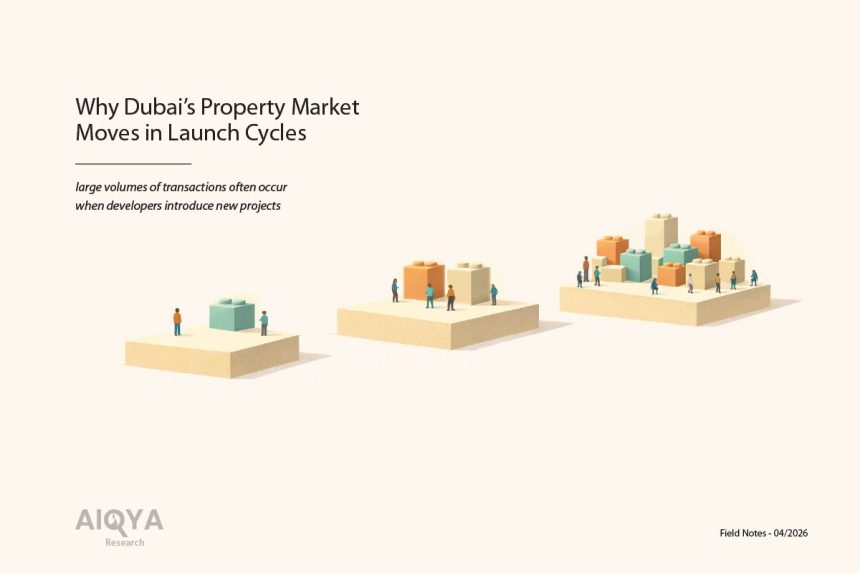
Dubai property launch cycles play an important role in shaping the rhythm of the emirate’s residential market. Instead of supply entering the market evenly over time, large volumes of transactions often occur when developers introduce new projects through carefully structured launch phases.
Key Takeaways
✔ Dubai’s residential market often moves in launch-driven cycles.
Transaction activity frequently rises when major residential projects are introduced to the market.
✔ Developers typically release projects in carefully structured phases.
Phased launches allow developers to test demand, manage pricing, and control inventory throughout the construction cycle.
✔ Early buyers play a key role in shaping launch momentum.
Investors who enter projects during the initial release phases often influence early sales absorption and pricing progression.
✔ Launch periods can create noticeable spikes in transaction data.
Sudden increases in quarterly transaction volumes may reflect the timing of project launches rather than a sudden change in underlying demand.
✔ Launch cycles remain central to Dubai’s development model.
They allow developers to finance large projects while enabling buyers to participate in the market during the construction phase.
Real estate markets are often perceived as moving gradually, with supply and demand adjusting slowly over time. In Dubai, however, residential activity frequently unfolds in waves rather than in a steady progression.
Periods of relatively moderate transaction activity are often followed by sudden spikes in sales volumes. These surges are rarely accidental. In many cases, they coincide with the launch of major residential projects by developers.
This pattern reflects an important structural feature of Dubai’s property market: a large share of transactions occurs during the early stages of new project launches. Instead of entering the market primarily through completed properties, many buyers participate during the development phase itself.
As a result, the timing of project launches often shapes the rhythm of market activity. Transaction volumes rise when new developments enter the market and stabilise once the initial phases of sales are absorbed.
Understanding this launch-driven dynamic offers an important perspective on how Dubai’s property market evolves over time. Beneath the visible skyline of completed towers lies a development cycle in which many of the most significant transactions occur at the moment new projects are introduced to the market.
The Launch-Driven Structure of Dubai’s Property Market
Unlike many mature housing markets where transactions are distributed relatively evenly across the year, Dubai’s residential market is strongly influenced by the timing of new project launches.
Developers frequently introduce large residential projects in carefully planned phases. Each launch may release a portion of the project’s total inventory, allowing developers to gauge demand while maintaining pricing flexibility as the development progresses.
These launch phases often generate concentrated bursts of transaction activity. When a major project is introduced to the market, buyers and investors move quickly to secure units during the initial release. As a result, transaction volumes can rise sharply during launch periods.
This structure means that a significant portion of market activity is linked not only to overall housing demand but also to the timing of developer sales strategies. The introduction of new inventory through project launches can therefore create distinct cycles of heightened transaction activity.
Over time, these cycles have become a recurring feature of Dubai’s property market, shaping how supply enters the market and how buyers participate in new developments.
Why Developers Release Projects in Phases
Large residential developments in Dubai are rarely released to the market all at once. Instead, developers typically introduce projects in carefully structured phases, with a portion of the total inventory made available during each launch stage.
This phased approach serves several practical purposes.
First, it allows developers to test market demand. Early launch phases provide immediate feedback on buyer interest, helping developers understand how the project is being received. Strong early sales may allow developers to adjust pricing for later phases, while slower absorption can prompt changes in marketing strategy or payment structures.
Second, phased launches help developers manage price discovery. When projects are introduced to the market, initial pricing is often positioned to attract early buyers and generate momentum. As units are absorbed and construction progresses, developers may gradually revise pricing in subsequent release phases.
Third, this approach allows developers to manage inventory more strategically. By releasing units over time rather than all at once, developers can maintain a steady flow of sales activity throughout the development cycle.
For buyers and investors, this structure creates a distinct launch window during which demand tends to concentrate. Early phases often attract significant attention, as buyers seek to secure units before prices are adjusted in later stages of the project.
Over time, this phased release strategy has become a defining feature of Dubai’s development model, influencing both pricing dynamics and transaction activity across the residential market.
How Early Buyers Shape Launch Momentum
The initial phases of a project launch often attract a specific category of buyers who play an important role in shaping early sales momentum.
Many investors actively monitor developer announcements and project releases, seeking opportunities to enter developments during the earliest stages of the launch cycle. Early participation allows buyers to secure units before the project progresses through later sales phases, when pricing may be adjusted upward as inventory becomes limited.
For some investors, this early entry point represents an opportunity to participate in the development cycle itself. As construction advances and demand builds, price adjustments across later phases of the project can gradually increase the value of earlier purchases.
In some cases, buyers may choose to exit their positions before project completion through resale opportunities permitted by developers and market conditions. Others may hold their units until handover and convert them into long-term rental assets.
This behaviour means that early buyers often play a key role in establishing momentum for newly launched projects. Strong participation during the first phases of a launch can create visibility and confidence around a development, attracting additional buyers in subsequent release stages.
As a result, the initial response to a project launch can influence how the entire development cycle unfolds, shaping both pricing progression and the pace at which inventory is absorbed by the market.
Why Launch Cycles Create Transaction Surges
Because a large share of Dubai’s residential supply enters the market through project launches, transaction volumes often rise sharply when new developments are introduced.
When a major project is launched, a significant number of units may become available for sale within a short period of time. Buyers who have been monitoring the market often move quickly during these early release windows, resulting in concentrated bursts of transaction activity.
These launch events can therefore produce noticeable spikes in market data. Quarterly transaction volumes may increase significantly during periods when several large developments enter the market simultaneously. Once the initial phases of these projects are absorbed, transaction activity may stabilise until the next round of launches occurs.
This pattern means that fluctuations in transaction volumes do not always reflect sudden shifts in underlying housing demand. In many cases, they simply reflect the timing of new project releases and the concentration of early-stage sales.
For analysts and market observers, recognising this launch-driven structure is important when interpreting market data. Periods of elevated transaction activity often coincide with the introduction of new supply rather than a structural change in buyer behaviour.
Risks of a Launch-Driven Market
While launch cycles support the rapid introduction of new housing supply, markets that rely heavily on early-stage project sales can also experience periods of volatility.
Because a large share of transactions occurs during the development phase, buyer sentiment plays an important role in determining how quickly projects are absorbed. When investor confidence is strong, newly launched developments can generate substantial transaction activity within a short period of time.
However, if broader economic conditions change or investor sentiment weakens, demand for projects under construction may slow. In such situations, developers may need to adjust pricing strategies, introduce revised payment plans, or delay future project launches.
Another potential challenge arises when multiple large developments enter the market simultaneously. A surge of new inventory can increase competition among projects, particularly within similar price bands or locations. In these circumstances, developers must carefully balance supply releases with prevailing market demand.
For buyers and investors, understanding these dynamics is important when evaluating opportunities in the off-plan segment. While launch phases can present attractive entry points, they also reflect a development cycle in which market conditions may evolve over the construction period.
Despite these risks, launch-driven sales remain a central feature of Dubai’s real estate ecosystem. When supported by strong demand and effective regulatory oversight, they have enabled the city to expand its housing supply at a pace rarely seen in other global markets.
Why Launch Cycles Remain Central to Dubai’s Development Model
Despite the cyclical nature of project launches, the launch-driven structure of Dubai’s property market continues to play an important role in supporting the city’s development model.
New residential supply in Dubai often emerges through large master-planned communities or major tower developments that require significant capital and long construction timelines. Launch phases allow developers to introduce these projects to the market while construction is still underway, enabling buyers and investors to participate earlier in the development cycle.
This structure aligns the interests of developers, investors, and the broader market. Developers gain early visibility into demand for new projects, while buyers gain access to new inventory through staged payment structures that spread financial commitments over time.
Launch cycles also allow the market to absorb supply gradually. Instead of introducing all available units simultaneously, developers can adjust the pace of releases based on demand conditions and buyer response.
Over time, this mechanism has helped Dubai sustain a steady expansion of its housing stock while maintaining active transaction volumes across different stages of the development cycle.
Beneath the skyline of completed buildings lies a development system in which the introduction of new projects often sets the rhythm of market activity.
You may also like:
How Dubai Developer Payment Plans Reshaped Property Investment
Dubai Mid-Market Property: Why the AED 1M–2M Band Powers the Housing Market
Why Dubai Off-Plan Property Dominates the Residential Market
Dubai Real Estate Investment: Why Global Capital Continues to Flow Through the Market