
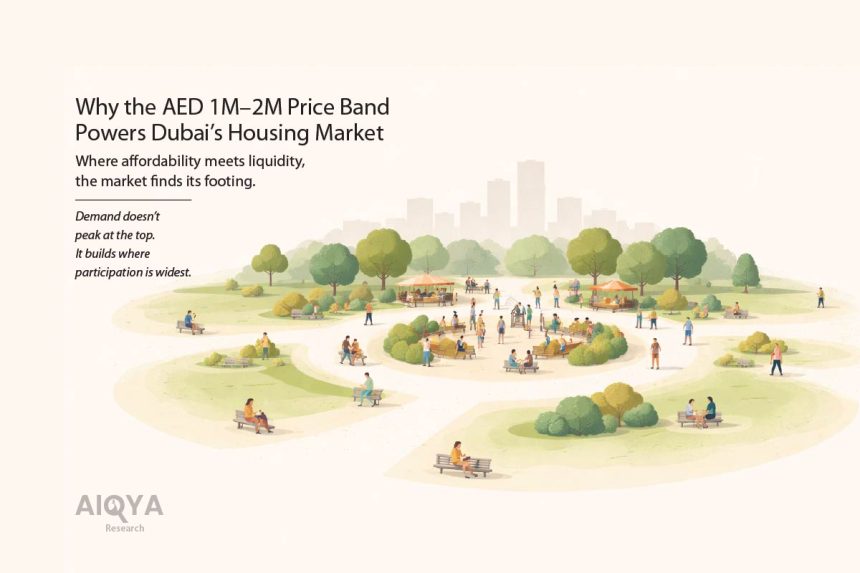
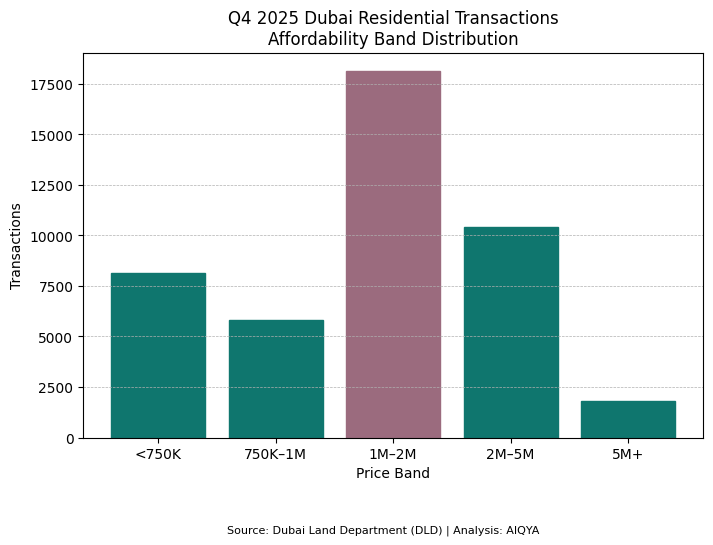
Dubai mid-market property has quietly become one of the most active segments of the emirate’s housing market. Apartments priced between AED 1 million and AED 2 million consistently attract both residents and investors, creating a segment that drives a significant share of Dubai’s residential property transactions.
Key Highlights
• Dubai mid-market property drives the bulk of residential transactions
Apartments priced between AED 1M and AED 2M form the most active segment of the housing market, consistently accounting for the highest share of transaction volume.
• This price band sits at the intersection of affordability and liquidity
It aligns with mortgage eligibility for residents while remaining accessible to global investors seeking entry-level exposure to Dubai real estate.
• Demand is reinforced by financing structures
Mortgage thresholds for ready homes and staged payment plans for off-plan developments both converge within this band, concentrating buyer activity.
• Compact configurations power the segment’s liquidity
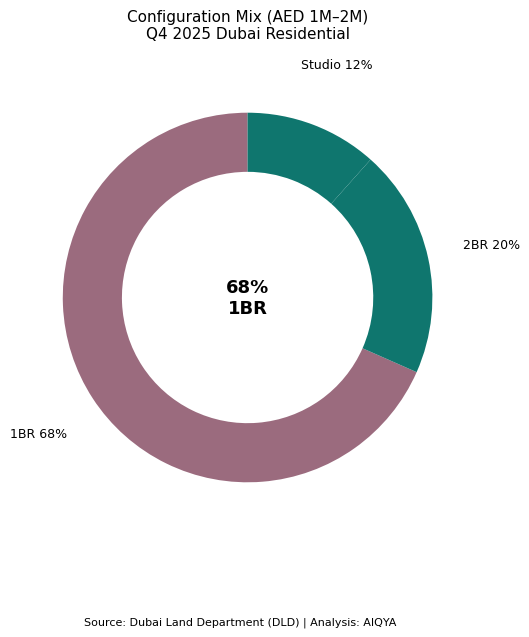
One-bedroom and compact two-bedroom units dominate transactions, making this segment highly adaptable for both end-users and rental investors.
• Developers actively design supply around this price range
Across multiple micro-markets, new launches are increasingly structured to fall within the AED 1M–2M band, reflecting sustained and predictable demand.
• The segment functions as the market’s liquidity backbone
While luxury assets capture attention, it is this mid-market band that sustains day-to-day transaction flow and supports overall market stability.
• Dubai’s housing market is sustained from the middle, not the top
The AED 1M–2M segment quietly anchors both demand and supply, making it one of the most structurally important layers of the market.
The Quiet Engine of Dubai’s Housing Market
Dubai’s real estate market often attracts global attention for its headline-grabbing luxury transactions. Waterfront penthouses, branded residences, and ultra-high-value villas regularly dominate international property news. Yet beneath these high-profile deals lies a far more important segment of the market, one that quietly drives a large share of transaction activity each year.
Apartments priced between approximately AED 1 million and AED 2 million have increasingly become the most active segment of Dubai’s residential property market. These homes rarely make global headlines, but they form the transactional backbone of the city’s housing ecosystem.
Several factors contribute to the strength of this price band. It sits at a point where affordability, financing access, and rental demand intersect. For many salaried residents purchasing their first property, this range represents the most accessible entry into the housing market. At the same time, it also aligns with the investment budgets of international buyers seeking relatively liquid assets in a globally connected city.
The result is a segment that attracts both end-users and investors simultaneously. While luxury properties capture attention, it is often the mid-market apartment segment that sustains the day-to-day momentum of Dubai’s property transactions.
Understanding why this particular price range remains so active provides a useful window into the deeper structure of the city’s housing market.
Why the AED 1M–2M Band Attracts Both Residents and Investors
The strength of the AED 1M–2M segment is not accidental. It sits at a point where several different sources of demand converge within Dubai’s housing market.
For many long-term residents working in the city, this price range represents the most accessible pathway to property ownership. Salaried professionals, dual-income households, and first-time buyers often find that apartments within this band align closely with the mortgage thresholds offered by local banks. Loan eligibility, down payment requirements, and monthly instalments typically fall within manageable ranges for this group of buyers.
At the same time, the same price band attracts a different category of participant: international investors seeking relatively liquid residential assets. For overseas buyers looking to diversify capital geographically, apartments priced between AED 1 million and AED 2 million offer an entry point into Dubai’s real estate market without the larger capital commitments required in the luxury segment.
The configuration of homes within this band also contributes to its liquidity. Studio apartments, one-bedroom units, and compact two-bedroom homes dominate the supply. These formats tend to perform well in the rental market, particularly in areas with strong connectivity to employment centres and transportation corridors.
As a result, properties within this segment often appeal simultaneously to two groups: residents purchasing homes for personal use and investors seeking rental income or future resale potential. This overlapping demand helps sustain consistent transaction activity across multiple market cycles.
In several growing residential micro-markets, including communities such as Jumeirah Village Circle, Arjan, Dubai South, and parts of Dubai Hills Estate – developers have increasingly structured apartment launches around this affordability band. The strategy reflects where demand from both residents and investors tends to converge.
Financing Structures That Concentrate Demand in This Band
Another important reason the AED 1M–2M segment remains so active lies in the structure of property financing available in Dubai.
For residents purchasing homes through mortgages, banks typically finance up to 75–80 percent of the property value for expatriate buyers, depending on eligibility and income levels. Within the AED 1M–2M range, the required down payment and monthly loan instalments often fall within a manageable threshold for many salaried professionals living in the city.
For example, a property priced near AED 1.5 million may require a down payment of roughly AED 300,000 to AED 375,000, with the remaining amount financed through a mortgage. For many residents who have spent several years working in Dubai, this level of savings aligns with the capital they are able to accumulate over time.
This financing structure naturally concentrates end-user demand within a particular price band. Homes priced significantly above this level require substantially larger down payments, which limits the pool of potential buyers.
At the same time, developers have introduced a second mechanism that further reinforces demand in this segment: structured off-plan payment plans. Many new residential projects allow buyers to pay for properties in instalments during the construction phase, with payment schedules spread across several years.
These payment structures lower the immediate capital requirement for investors and first-time buyers alike. As a result, apartments priced between AED 1M and AED 2M frequently become the preferred entry point for both groups.
The combination of mortgage accessibility for ready properties and structured payment plans for off-plan developments has therefore created a financing environment that repeatedly channels demand into this mid-market segment.
Over time, this has helped establish the AED 1M–2M band as one of the most liquid segments of Dubai’s residential property market.
Dubai’s housing market is sustained from the middle, not the top.
How Developers Design Supply Around the AED 1M–2M Segment
Over time, developers across Dubai have increasingly structured new residential launches around the AED 1M–2M price band. The strategy reflects a clear understanding of where consistent demand exists within the housing market.
In several growing residential micro-markets including Jumeirah Village Circle, Arjan, Dubai South, and parts of Dubai Hills Estate, apartment projects are often configured with unit sizes and layouts that fall naturally within this affordability range. Studio apartments, one-bedroom homes, and compact two-bedroom units dominate the mix in many new launches.
This approach allows developers to align supply with the segment that tends to generate the highest transaction volumes. While luxury developments in prime waterfront locations continue to attract attention, mid-market apartment projects often deliver the steady stream of transactions that sustain the broader market.
Location also plays an important role. Many of these micro-markets offer relatively good connectivity to major employment corridors, business districts, and transportation infrastructure. Areas such as JVC and Arjan provide access to key road networks, while Dubai Hills Estate benefits from its proximity to central business zones and healthcare and retail infrastructure.
By combining manageable unit sizes with competitive price points, developers are able to position new projects squarely within the segment where both resident buyers and investors remain active. This alignment between supply strategy and buyer affordability helps maintain consistent absorption across multiple market cycles.
As a result, the AED 1M–2M segment has gradually become one of the most dependable sources of residential transaction activity in the emirate.
The Liquidity Backbone of Dubai’s Housing Market
Taken together, these patterns help explain why the AED 1M–2M segment continues to play such an important role in Dubai’s residential property market. It is the point where several different forces intersect: affordability for residents, manageable investment thresholds for international buyers, accessible mortgage financing, and developer supply strategies designed around consistent demand.
What appears as a mid-market segment is, in reality, the liquidity engine of Dubai’s residential ecosystem.
While luxury properties and record-breaking transactions often dominate headlines, the broader health of the market depends on the steady flow of activity within this mid-market band. Apartments in this segment tend to change hands more frequently, attract a wider pool of buyers, and maintain relatively stable rental demand across different economic cycles.
In many ways, this price range functions as the liquidity backbone of the housing market. It is where first-time buyers enter the property ladder, where investors deploy capital into rental assets, and where developers can launch projects with a reasonable expectation of absorption.
Understanding this segment therefore offers a useful perspective on how Dubai’s real estate market operates beneath the surface of its more visible luxury developments. Behind the skyline of high-profile towers and waterfront residences, the day-to-day momentum of the market is often sustained by homes priced within this relatively accessible band.
And over time, that quiet consistency may be one of the reasons Dubai’s housing market continues to attract both residents and investors from around the world.
You may also like:
Dubai Q4 2025 Apartment Market Report: Off-plan Dominance, Pricing, and Buyer Signals
Why Dubai Off-Plan Property Dominates the Residential Market
Dubai Real Estate Investment: Why Global Capital Continues to Flow Through the Market