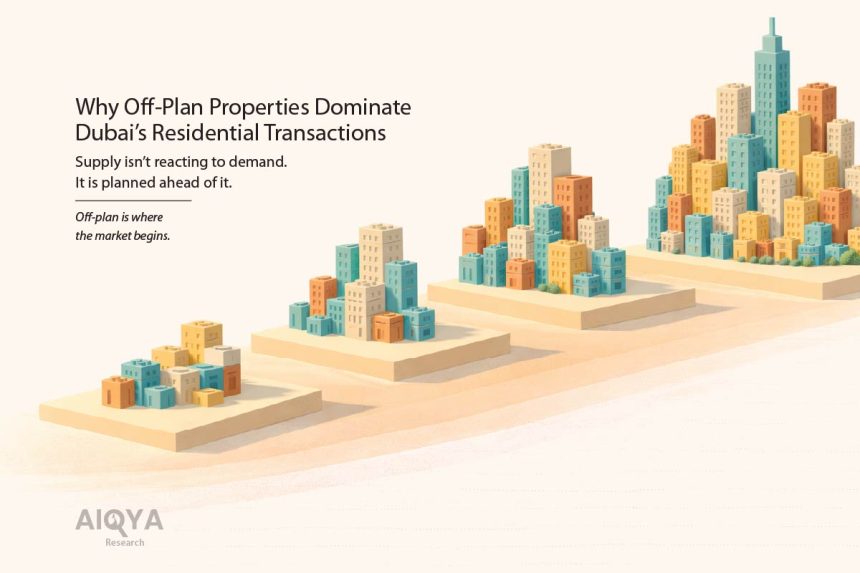
Dubai off-plan property has become one of the most active segments of the emirate’s housing market. A large share of residential transactions now occurs during the construction phase, as developers launch projects with structured payment plans that allow buyers to enter the market gradually rather than through a full upfront purchase.
Key Takeaways
• Off-plan transactions dominate Dubai’s residential market.
A significant share of apartment sales occurs during the construction phase rather than after project completion.
• Developer payment plans have expanded the buyer base.
Staged instalments allow investors and residents to enter the market without committing the full property value upfront.
• Early-stage buyers often participate in the development cycle itself.
Purchasing during project launches allows investors to benefit from price adjustments as construction progresses.
• Off-plan sales also serve as a financing mechanism for developers.
Buyer instalments during construction help fund large residential projects and reduce reliance on external financing.
• Regulatory safeguards have strengthened confidence in the market.
Escrow frameworks and regulatory oversight have helped stabilise off-plan transactions and improve buyer protection.
The Off-Plan Phenomenon
In most global housing markets, homes are bought after they are built.
In Dubai, however, a large share of residential transactions takes place long before construction is completed.
In many mature real estate markets, most property transactions occur after buildings are completed. Buyers typically purchase finished homes, allowing them to evaluate the property, the neighbourhood, and the surrounding infrastructure before committing to the investment.
Dubai’s residential market operates somewhat differently.
A significant portion of property transactions in the city take place before construction is completed, through what is commonly referred to as the off-plan market. In these transactions, buyers commit to purchasing units while projects are still under development, often several years before the buildings are ready for handover.
This structure has become one of the defining characteristics of Dubai’s property ecosystem. Developer launches frequently generate substantial transaction activity during the early stages of construction, with buyers securing units based on floor plans, project concepts, and future delivery timelines.
For developers, off-plan sales provide an effective mechanism for financing large residential projects. For buyers, the structure offers an opportunity to enter the market with staged payment schedules rather than a full upfront purchase.
Over time, this system has evolved into one of the primary ways through which capital flows into Dubai’s housing market. While completed homes continue to trade actively, it is often the off-plan segment that accounts for a substantial share of overall residential transactions in the emirate.
Understanding how this system works offers an important perspective on the mechanics of Dubai’s property market.
How Payment Plans Reshaped Buyer Behaviour
One of the most important factors behind the rise of off-plan transactions in Dubai is the widespread use of developer-structured payment plans.
Unlike traditional property purchases that require a large upfront payment or immediate mortgage financing, off-plan projects often allow buyers to pay for homes in stages over several years. These payment schedules are typically linked to construction milestones or predefined timelines.
A common structure may begin with a booking amount of 10 to 20 percent, followed by instalments spread across the construction period. In some projects, developers also offer post-handover payment plans that extend several years beyond project completion.
For many buyers, this structure significantly lowers the immediate capital required to enter the market. Instead of committing the full property value upfront, investors and residents can deploy capital gradually as the project progresses.
This staged payment model has two important effects on the market. First, it broadens the pool of potential buyers by making property ownership accessible to individuals who may not yet qualify for a mortgage or who prefer to preserve liquidity. Second, it allows investors to participate in projects earlier in the development cycle, often before prices begin adjusting as construction advances.
As a result, payment plans have become one of the central mechanisms through which developers attract demand during the early phases of a project launch. In many cases, the structure of these payment schedules plays just as important a role as the property itself in shaping buyer interest.
Over time, this financing model has helped transform off-plan sales into a dominant channel for residential transactions across Dubai’s property market.
Why Investors Gravitate Toward Off-Plan Properties
Beyond payment flexibility, off-plan properties also appeal to investors for a different reason: the potential for value appreciation during the construction period.
When buyers purchase units early in a project’s launch cycle, prices are often positioned at a level designed to attract initial demand. As construction progresses and inventory begins to sell through, developers may adjust prices in later phases of the project. Early buyers therefore sometimes benefit from gradual price increases as the development advances toward completion.
This dynamic creates an additional incentive for investors to enter projects during the early stages of construction. The opportunity to secure a unit before a project is fully built allows investors to participate in the development cycle rather than only in the completed property market.
Off-plan properties can also provide flexibility through resale opportunities prior to handover, depending on developer policies and market conditions. Some investors choose to exit positions before project completion, while others hold the property until delivery and then transition it into a rental asset.
The relatively manageable entry thresholds of many off-plan units, particularly within the AED 1M–2M price band, further strengthen this appeal. Investors seeking exposure to Dubai’s real estate market often find that staged payments combined with potential capital appreciation create a structure that aligns well with their investment strategies.
Together, these factors have helped position off-plan developments as one of the most active segments of Dubai’s residential property market.
Why Developers Rely on Off-Plan Sales
While off-plan structures provide flexibility for buyers, they also serve an equally important function for developers.
Large residential projects require significant capital commitments long before construction is completed. Land acquisition, design development, contractor mobilisation, and early-stage construction all demand substantial upfront investment. Off-plan sales allow developers to begin recovering part of these costs during the development phase itself.
By launching projects and opening sales early in the construction cycle, developers can generate revenue streams that support the continuation of the project. Buyer instalments collected during construction help finance ongoing building activity, reducing the need for developers to rely entirely on external funding sources.
This system also allows developers to gauge market demand more effectively. Early sales performance often provides a useful signal of how a project is being received by buyers, allowing developers to adjust pricing strategies or marketing approaches as construction progresses.
In addition, phased sales releases enable developers to manage inventory over time. Units may be introduced to the market in stages, with prices adjusted gradually as demand builds and the project advances toward completion.
Together, these mechanisms have made off-plan sales an integral part of the development model used across Dubai’s residential property sector. The system aligns developer financing needs with buyer demand, creating a structure that has supported the rapid expansion of the city’s housing supply over the past two decades.
How Regulation Stabilised the Off-Plan Market
Dubai’s off-plan market did not evolve without regulatory safeguards. Following the global financial crisis of 2008, authorities introduced a series of measures designed to strengthen buyer protection and improve transparency within the development process.
One of the most important mechanisms was the introduction of escrow accounts for real estate projects. Under this system, funds collected from buyers are deposited into dedicated accounts and can only be released to developers in stages as construction progresses.
This structure helps ensure that buyer payments are used for the development of the project itself rather than diverted to unrelated activities. For investors, the escrow system significantly improved confidence in purchasing properties during the construction phase.
Over time, these regulatory frameworks helped stabilise the off-plan market and restored trust following earlier development cycles. Today, they form an essential part of the institutional structure that supports Dubai’s property development ecosystem.
The Advantages and Risks of an Off-Plan Driven Market
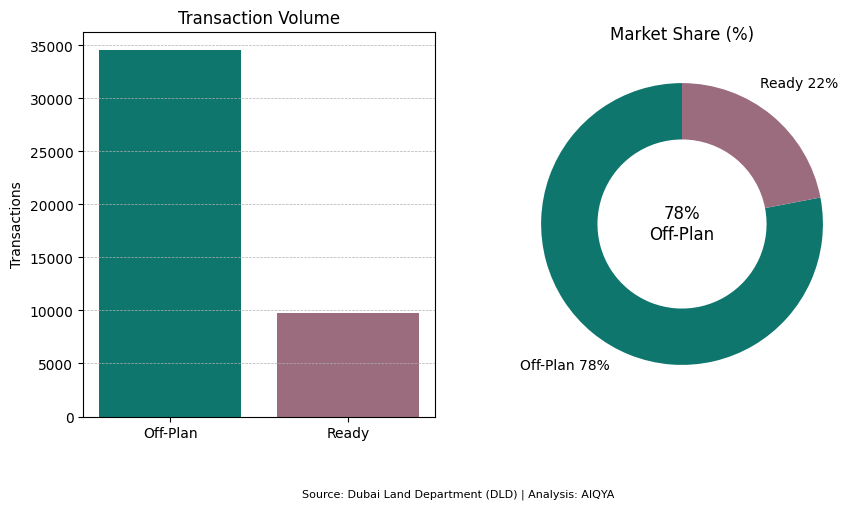
Taken together, these factors help explain why off-plan properties continue to account for a substantial share of residential transactions in Dubai. Transaction data reflects how dominant this segment has become. In Q4 2025, more than three quarters of apartment transactions in Dubai occurred in the off-plan segment, underscoring how central this development model has become to the emirate’s housing market. Staged payment plans, investor participation during the construction cycle, and developer financing structures have all contributed to the growth of this segment over time.
Oversight from authorities such as the Dubai Land Department and the Real Estate Regulatory Agency (RERA) further strengthened the regulatory framework governing new developments.
For the market as a whole, the off-plan system offers several advantages. It allows developers to launch new supply efficiently, provides buyers with flexible entry points into property ownership, and enables capital to flow into projects long before completion. In a rapidly expanding city, this mechanism has played a significant role in supporting the pace of residential development.
At the same time, markets that rely heavily on off-plan sales can also experience periods of volatility. If investor sentiment weakens or economic conditions shift, demand for projects under construction may slow, creating pressure on developers and buyers alike. For this reason, the health of the off-plan segment often reflects broader confidence in the property market.
Despite these cyclical dynamics, the off-plan model remains a defining feature of Dubai’s real estate ecosystem. It shapes how projects are financed, how buyers participate in the market, and how new housing supply enters the city over time.
Understanding this structure, therefore, provides valuable insight into the mechanics of Dubai’s property market. Beneath the skyline of completed towers and master-planned communities lies a development system in which many of the most significant transactions occur long before the buildings themselves are finished.
AIQYA Insight
Off-plan dominance is not simply a sales phenomenon. It reflects how Dubai’s development model allows projects to attract capital long before completion, effectively turning construction pipelines into investment opportunities.
In Dubai’s real estate market, the skyline may be visible to everyone.
But many of the most important transactions occur years before those towers are complete.
You may also like:
Dubai Q4 2025 Apartment Market Report: Off-plan Dominance, Pricing, and Buyer Signals
Dubai January 2026 Market Analysis: The Structure Behind the Numbers
Dubai Residential Market February 2026 Analysis
Dubai Real Estate Investment: Why Global Capital Continues to Flow Through the Market