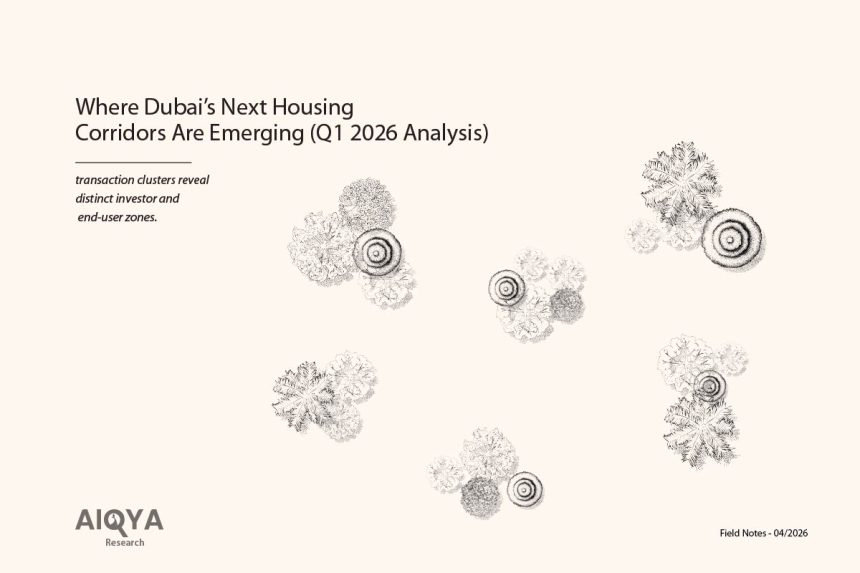
Dubai housing corridors are shaping where the city’s residential growth is concentrating in Q1 2026. Transaction data reveals clear clusters driven by distinct buyer behaviour.
- Market Overview – A Corridor-Driven Market
- Q1 2026 Corridor Snapshot – Where Activity Is Concentrating
- The Five Active Housing Corridors (Q1 2026)
- 1. The Liquidity Corridor – JVC, Arjan, Sports City Belt
- 2. The Expansion Corridor – Dubai South / Madinat Al Mataar
- 3. The Mid-Market Expansion Belt – Dubailand Cluster
- 4. The Stability Corridor – MBR / Meydan
- 5. The Emerging Waterfront Corridor – Deira / Palm Deira
- Why These Corridors Are Forming
- Corridor Dynamics – What the Data Reveals
- Buyer Profile – A Two-Speed Corridor Market
- Risks & Watchpoints
- Observations – A City Growing in Lines, Not Layers
Dubai’s housing market is no longer expanding uniformly. It is consolidating into corridors where liquidity, pricing, and demand align.”
Cities don’t grow evenly. They stretch, cluster, and extend along lines of movement, access, and opportunity.
Dubai has always followed this pattern. From the early rise of Dubai Marina and Downtown Dubai to the expansion of Business Bay, each phase of the city’s growth has unfolded through distinct corridors shaped by infrastructure and developer momentum.
But Q1 2026 makes this pattern measurable.
The market is no longer just expanding. It is sorting itself into corridors of activity, where transactions, pricing, and buyer intent begin to cluster in predictable ways.
These corridors are not defined by marketing names alone. They are visible in transaction data, often under technical area classifications that precede how the market eventually recognizes them.
Understanding where these clusters are forming offers a clearer view of how Dubai’s housing landscape is evolving, and where its next phase of growth is likely to consolidate.
Market Overview – A Corridor-Driven Market
Q1 2026 transaction data shows a clear pattern:
- Activity is concentrated, not dispersed
- A handful of micro-markets account for a disproportionate share of transactions
- These micro-markets align into 4–5 emerging corridors
What appears as a fragmented market on the surface is, in reality, a structured expansion model.
📝 Interpretation
Dubai’s growth is no longer about new locations emerging independently. It is about clusters reinforcing each other, forming corridors of supply, pricing, and liquidity.
🧭 AIQYA Insight
This is a corridor market, not a city-wide market.
And each corridor behaves differently.
Q1 2026 Corridor Snapshot – Where Activity Is Concentrating
| Corridor | Key Micro-markets (Dataset) | Share of Transactions | Price Band (AED/sqft) | Off-plan Share | Buyer Type |
| Liquidity Corridor | JVC, Arjan, Sports City, Motor City | High (dominant cluster) | Low–Mid | Very High | Investor-led |
| Expansion Corridor | Madinat Al Mataar (Dubai South) | Moderate (growing) | Low | Very High | Early-stage investors |
| Mid-Market Belt | DLRC, Majan | High | Low–Mid | High | Value seekers |
| Stability Corridor | MBR (Hadaeq Sheikh Mohammed Bin Rashid) | Moderate | Mid–High | Balanced | End-users / Upgraders |
| Waterfront Transition | Palm Deira, Al Khairan First | Moderate | Mid | Mixed | Hybrid (investor + end-user) |
📝 Interpretation
Transaction concentration is not evenly spread.
Two corridors (JVC belt + Dubailand) account for the bulk of activity, while others are still forming or stabilizing.
🧭 AIQYA Insight
The market is not just segmented by price.
It is segmented by corridor behaviour.
The real decision in today’s market is not which project to buy, but which corridor of growth to enter.”
The Five Active Housing Corridors (Q1 2026)
1. The Liquidity Corridor – JVC, Arjan, Sports City Belt
Anchored around:
- Jumeirah Village Circle
- Arjan
- Dubai Sports City
- Motor City
This is the engine of transaction volume.
- High density of apartments
- Strong off-plan supply
- Accessible ticket sizes
📝 Interpretation
This corridor absorbs the bulk of investor-driven demand, particularly in compact configurations.
🧭 AIQYA Insight
This is Dubai’s liquidity engine.
Transactions move fast here, but price movement tends to be gradual and volume-driven.
2. The Expansion Corridor – Dubai South / Madinat Al Mataar
Anchored around:
- Madinat Al Mataar (Dubai South / Expo region)
- Proximity to Al Maktoum International Airport
This corridor is still forming, defined more by expectation than maturity.
- Large land availability
- Infrastructure-led positioning
- Early-stage pricing
📝 Interpretation
This corridor is still forming. Transactions reflect anticipation of future growth, not present-day maturity.
🧭 AIQYA Insight
This is a long-horizon bet.
It attracts investors willing to wait for infrastructure and ecosystem build-out.
3. The Mid-Market Expansion Belt – Dubailand Cluster
Anchored around:
- Dubai Land Residence Complex (DLRC)
- Majan
Here, scale meets affordability.
- Large supply pipelines
- Competitive pricing
- Mix of apartments and townhouses
📝 Interpretation
This corridor captures buyers priced out of central districts but still seeking urban connectivity.
🧭 AIQYA Insight
This is a volume expansion zone – a bridge between affordability and accessibility.
4. The Stability Corridor – MBR / Meydan
Anchored around:
- Hadaeq Sheikh Mohammed Bin Rashid (MBR City)
Close to:
- Downtown Dubai
- Business Bay
This is a proximity-driven corridor.
- Higher ticket sizes
- Lower transaction churn
- Strong end-user presence
📝 Interpretation
Demand here is less about entry price and more about location, brand, and long-term livability.
🧭 AIQYA Insight
This is the market’s lifestyle ballast – slower, steadier, and more resilient.
5. The Emerging Waterfront Corridor – Deira / Palm Deira
Anchored around:
- Palm Deira
This is a re-emerging legacy corridor.
- Significant transaction activity
- Waterfront positioning
- Ongoing redevelopment
📝 Interpretation
This corridor reflects how older parts of Dubai are being repositioned into new residential formats.
🧭 AIQYA Insight
This is a transition corridor- part regeneration, part expansion.
Unlike greenfield corridors, this zone builds on existing urban fabric, making its growth less speculative and more layered.
Why These Corridors Are Forming
Across all five corridors, the same structural drivers repeat:
- Land availability → enables scale
- Infrastructure access → enables viability
- Masterplanned development → enables clustering
- Pricing advantage → enables early demand
Developers are not choosing locations randomly.
They are responding to where these factors align simultaneously.
Corridor Dynamics – What the Data Reveals
1. Liquidity vs Stability Split
| Corridor Type | Typical Unit Mix | Transaction Velocity | Price Movement | Risk Profile |
| Liquidity Corridors | Studios, 1BR, compact 2BR | High | Gradual | Low entry, moderate volatility |
| Stability Corridors | 2BR, 3BR, larger formats | Moderate–Low | Steady | Higher entry, lower volatility |
📝 Interpretation
Compact units drive volume, while larger homes anchor long-term stability.
2. Off-Plan Dominance by Corridor
| Corridor | Off-Plan Dominance | Market Signal |
| JVC / Arjan | Very High | Continuous launch cycles |
| Dubai South | Extremely High | Future-led positioning |
| Dubailand | High | Scale-driven expansion |
| MBR / Meydan | Moderate | Balanced demand |
| Waterfront | Mixed | Transition phase |
📝 Interpretation
Off-plan is strongest where land availability + pricing advantage align.
🧭 AIQYA Insight
Corridors with high off-plan share are not just growing – they are being actively manufactured by developer pipelines.
3. Price Positioning Across Corridors
| Corridor | Typical Ticket Size | Market Position |
| JVC / Arjan | Entry–Mid | Liquidity-driven |
| Dubailand | Entry–Mid | Value expansion |
| Dubai South | Entry | Future growth play |
| MBR / Meydan | Mid–Premium | Lifestyle + proximity |
| Waterfront | Mid–Premium | Regeneration + positioning |
📝 Interpretation
Price is not random.
Each corridor occupies a distinct affordability band.
Corridor Lifecycle – Where Each Zone Stands
| Corridor | Stage | What It Means |
| Dubai South | Early | Infrastructure-led growth, long horizon |
| Dubailand | Growth | Rapid supply expansion |
| JVC / Arjan | Mature Liquidity | High churn, stable demand |
| MBR / Meydan | Stabilizing Premium | End-user driven |
| Waterfront | Transition | Repositioning phase |
🧭 AIQYA Insight
Dubai doesn’t just build locations.
It builds corridor life cycles – from early-stage speculation to mature residential ecosystems.
Buyer Profile – A Two-Speed Corridor Market
The corridors reveal a clear divide:
Investor-driven corridors
- JVC / Arjan
- Dubailand
- Dubai South
Focus:
- Entry price
- Rental yield
- Payment plans
End-user / upgrader corridors
- MBR / Meydan
- Select waterfront zones
Focus:
- Location
- Community maturity
- Long-term living
🧭 AIQYA Insight
Dubai is operating as a two-speed market:
- One driven by liquidity and yield
- The other anchored in lifestyle and stability
Most buying mistakes in Dubai today are not project-level errors, they are corridor misreads.
Risks & Watchpoints
Not all corridors are meant for the same kind of buyer, and not all growth translates into livability.
Emerging corridors come with trade-offs:
- Infrastructure lag → especially in early-stage zones
- Supply clustering → temporary oversupply risk
- Dependency on execution timelines
Not all corridors mature at the same pace.
Observations – A City Growing in Lines, Not Layers
Dubai’s next phase of growth is not happening everywhere.
It is happening along corridors.
Each corridor represents a different balance:
- Liquidity vs stability
- Price vs proximity
- Present value vs future potential
For buyers and investors, the question is no longer:
“Which project should I buy?”
But:
“Which corridor am I entering?”
In Dubai today, choosing a home is no longer about selecting a project. It is about choosing the growth pattern you want to belong to.
You may also like:
Dubai Property Market Q1 2026: Structure, Pricing and Demand Trends
Dubai Property Market March 2026: What Held Under Pressure
Dubai Real Estate Market March 2026 – A Measured Shift Toward Balance
Dubai Mid-Market Property: Why the AED 1M–2M Band Powers the Housing Market