Dubai developer payment plans have become one of the defining features of the city’s property market. Instead of relying solely on bank mortgages, buyers increasingly enter projects through staged instalments during construction. Over time, these structures have reshaped how capital flows into real estate and explain why off-plan transactions dominate residential activity.
Key Takeaways
• Developer payment plans have become a structural financing layer in Dubai’s real estate market.
• By spreading payments across construction timelines, these plans lower the capital barrier for buyers.
• Flexible instalment structures attract both residents and international investors into off-plan projects.
• Payment plans contribute to strong launch-phase demand and sustained transaction liquidity.
• Ultra-flexible instalment models are gradually reshaping how buyers evaluate property purchases.
The Rise of Developer Financing
In most mature real estate markets, property purchases are financed primarily through bank mortgages. Buyers secure a loan, commit a substantial down payment, and begin repayment once the property is completed. Buyers secure loans, commit a substantial down payment, and begin repaying the balance over a long repayment period after the property is completed.
Dubai’s residential market has evolved along a somewhat different path.
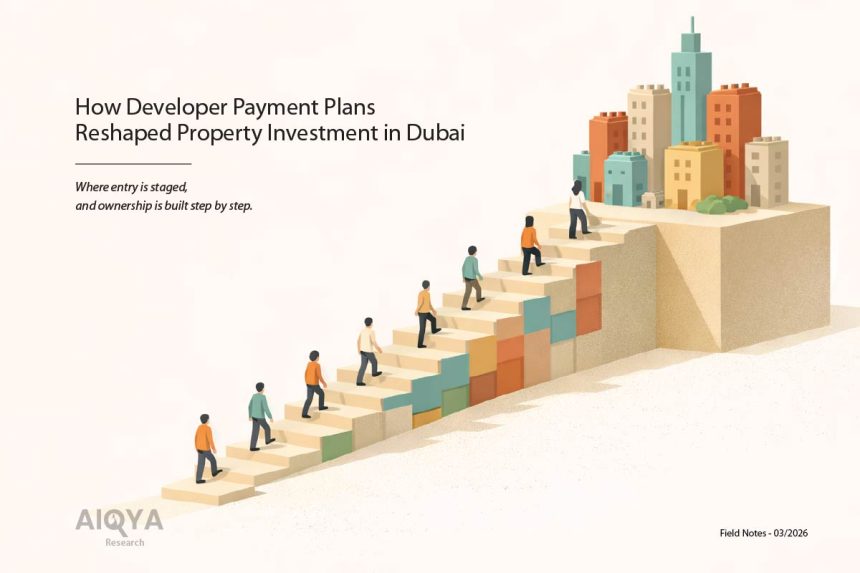
Over the past two decades, developers have increasingly introduced structured payment plans that allow buyers to purchase homes in instalments during the construction phase itself. Instead of relying entirely on mortgage financing at the time of completion, buyers often commit to projects years earlier, paying for the property gradually as the development progresses.
This approach has effectively positioned developers as an additional layer of financing within the housing market. By collecting instalments from buyers during construction, developers are able to support project cash flows while reducing reliance on external funding sources.
Developer payment plans have effectively turned real estate developers into an additional layer of financing within Dubai’s housing market.
For buyers, these payment structures create an alternative route into property ownership. Rather than securing a mortgage at the outset, they can begin participating in the market through staged payments that align with the construction timeline of the project.
Over time, this system has become one of the defining characteristics of Dubai’s real estate ecosystem. Developer payment plans now play a central role in how residential projects are launched, financed, and absorbed by the market.
Understanding this structure helps explain why Dubai’s property market operates differently from many traditional housing markets, and why off-plan transactions have become such a prominent feature of the city’s real estate activity.
How Payment Plans Lower Entry Barriers
One of the most significant effects of developer payment plans is the way they reduce the immediate capital required to enter the property market.
Traditional real estate purchases typically require buyers to commit a substantial amount of capital at the beginning of the transaction. Down payments, mortgage approvals, and associated transaction costs can create a high entry threshold, particularly for first-time buyers or investors seeking to diversify across multiple assets.
Developer payment plans reshape this structure by spreading the cost of a property over the entire construction period. Buyers usually begin with an initial booking amount, followed by instalments that are linked either to construction milestones or fixed time intervals. In many cases, these payments extend over several years before the property is completed.
This staged approach allows buyers to allocate capital gradually rather than committing the full purchase amount upfront. For many residents working in the city, this structure makes it easier to transition from renting to property ownership. Instead of saving the entire down payment required for a mortgage, buyers can begin investing earlier while the project is still under development.
The same mechanism also attracts investors who prefer to maintain liquidity while deploying capital into real estate. By committing funds progressively, investors are able to participate in projects without locking large amounts of capital into a single purchase at the outset.
Over time, these flexible payment structures have significantly broadened the pool of participants in Dubai’s property market, allowing both residents and international investors to enter the market at earlier stages of the development cycle.
Why Investors Gravitate Toward Payment Plan Structures
Beyond improving accessibility for residents, developer payment plans have also become particularly attractive to investors.
One reason lies in the way capital is deployed during the investment cycle. Instead of committing the full property value at the outset, investors are able to allocate funds gradually as construction progresses. This staggered deployment allows them to manage liquidity more efficiently while still participating in the real estate market.
In practical terms, this means that an investor who might previously have committed capital to a single property purchase can sometimes distribute the same funds across multiple projects launched at different times. By spreading commitments across several developments, investors are able to diversify exposure while maintaining flexibility in their capital allocation.
Payment plans also align well with the typical lifecycle of many off-plan projects. As construction advances and project visibility improves, market prices for remaining inventory may adjust upward. Investors who entered the project during earlier phases may therefore benefit from value appreciation as the development progresses toward completion.
This dynamic has contributed to the strong participation of investors in Dubai’s off-plan market. Rather than waiting for completed properties to enter the resale market, many investors prefer to participate earlier in the development cycle, where payment structures and pricing strategies often create additional opportunities.
Over time, this combination of flexible financing and staged capital deployment has made payment plan structures one of the central drivers of investor activity in Dubai’s residential property market.
By spreading payments across the construction cycle, developer financing lowers the capital barrier that traditionally defined property ownership.
How Payment Plans Accelerate Market Liquidity
Beyond influencing individual purchase decisions, developer payment plans also shape the broader dynamics of Dubai’s property market.
By allowing buyers to commit capital gradually, these financing structures significantly increase the number of participants who are able to enter the market during the early stages of a project launch. This expanded pool of buyers often leads to stronger absorption rates during the initial phases of new developments.
For developers, early sales play an important role in supporting the construction cycle. Projects that achieve strong launch-phase demand are better positioned to maintain construction momentum and manage project financing efficiently. As a result, payment plans have become an important mechanism through which developers are able to align project timelines with market demand.
From a market perspective, this structure contributes to higher transaction volumes, particularly within the off-plan segment. Buyers are able to secure units before completion, developers are able to launch new phases of projects with confidence, and capital continues to circulate through the development pipeline.
Over time, this system has helped sustain a development environment in which new residential projects can be introduced regularly while maintaining relatively strong absorption levels. Payment plans, therefore, play a role not only in attracting buyers but also in maintaining the liquidity that characterises Dubai’s real estate market.
While luxury transactions often attract public attention, a substantial portion of the market’s day-to-day activity is supported by this underlying financing structure that allows buyers to participate earlier in the development cycle.
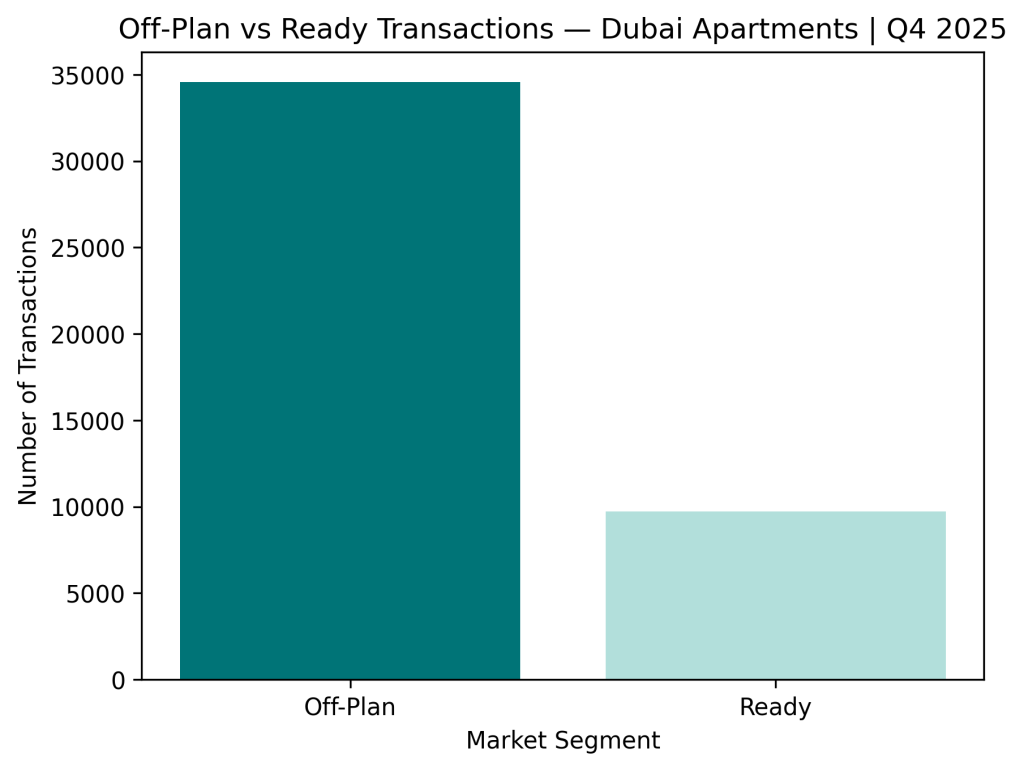
This financing structure is reflected in transaction patterns. In Q4 2025, more than three-quarters of residential apartment transactions in Dubai occurred in the off-plan segment, illustrating how strongly payment plan structures influence buyer participation.
Payment structures do more than attract buyers.
They sustain the liquidity that allows Dubai’s development pipeline to keep moving.
How Flexible Payment Plans Are Changing Buyer Psychology
In recent years, developer payment plans in Dubai have evolved beyond traditional construction-linked instalments. Some projects now offer highly extended payment structures in which buyers pay as little as one percent of the property value per month over several years.
At first glance, such plans appear to significantly reduce the cost of purchasing a property. In reality, the total value of the asset remains unchanged. What these structures primarily do is extend the timeline over which capital is deployed.
This shift has an important effect on how buyers evaluate property purchases.
Traditionally, purchasing real estate required buyers to consider the full value of the property and secure substantial upfront capital through savings or mortgage financing. Under extended payment models, however, the decision increasingly becomes framed around the monthly commitment rather than the total asset value.
Instead of evaluating whether they can afford the full value of a property, buyers increasingly evaluate whether the monthly instalment fits within their cash flow.
This reframing subtly transforms the nature of the transaction. Real estate, which historically required large upfront capital commitments, begins to resemble a long-term instalment purchase spread across several years.
For investors, this structure also expands flexibility. Because payments are distributed across an extended timeline, capital can be allocated across multiple projects simultaneously rather than concentrated in a single acquisition. This often contributes to strong launch-phase demand when new projects enter the market.
While such payment structures expand accessibility and stimulate participation, they also illustrate how financing models increasingly influence buyer behaviour within Dubai’s residential property market.
The Financing Structure Behind Dubai’s Off-Plan Market
Developer payment plans are sometimes viewed simply as marketing tools designed to attract buyers during project launches. In reality, they have become one of the structural mechanisms through which Dubai’s residential market operates.
By allowing buyers to distribute payments across several years, developers effectively lower the capital barrier required to participate in the market. This enables a broader range of investors and end users to enter projects during the construction phase rather than waiting for completed inventory.
The result is a development ecosystem where capital flows into projects earlier in their lifecycle.
For developers, this early participation helps secure project funding and maintain construction momentum. For buyers, the staggered payment structure reduces the need for large upfront capital commitments while preserving exposure to the underlying asset.
In Dubai’s real estate market, price determines what buyers purchase.
Payment structure often determines when they are willing to buy.
This alignment between developer financing and buyer participation has gradually become one of the defining characteristics of Dubai’s off-plan market.
It also explains why a significant portion of the emirate’s residential transactions continues to take place before project completion.
While luxury launches and record-breaking penthouse transactions often capture headlines, much of the market’s underlying activity is supported by these financing structures that allow capital to move into new developments in a steady and predictable manner.
Understanding how these payment models work therefore, provides a clearer picture of how Dubai’s property market sustains its development pipeline and continues to attract both local and international buyers.
In Dubai’s real estate market, price may determine what buyers purchase.
But payment structure often determines when they are willing to buy.
You may also like:
Dubai Q4 2025 Apartment Market Report: Off-plan Dominance, Pricing, and Buyer Signals
Why Dubai Off-Plan Property Dominates the Residential Market
Dubai Real Estate Investment: Why Global Capital Continues to Flow Through the Market
Dubai Mid-Market Property: Why the AED 1M–2M Band Powers the Housing Market