

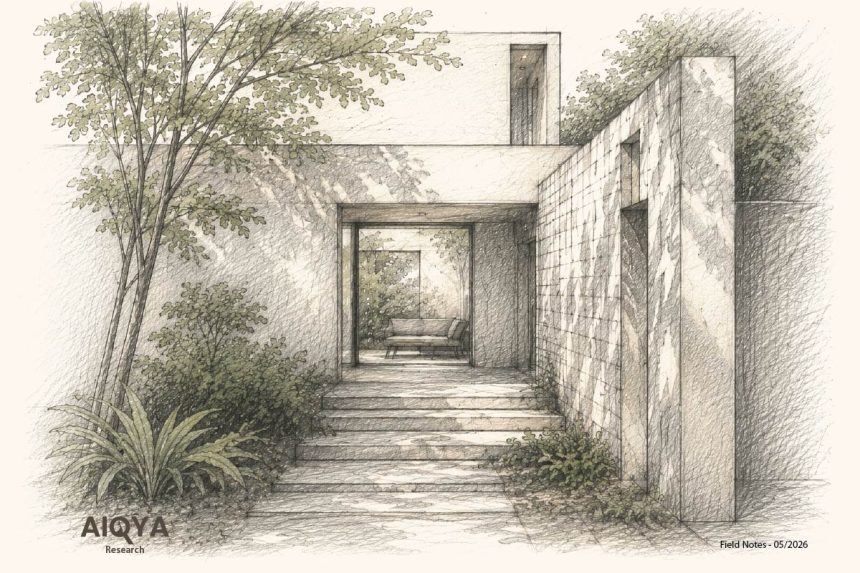
Privacy Without Walls is the idea that true privacy in architecture does not come from isolation, but from spatial control. Through distance, sightlines, thresholds, and orientation, well-designed environments allow occupants to remain connected while still feeling protected.
Field Notes by AIQYA Research
Privacy is not the absence of others.
It is the presence of choice.
Privacy is often mistaken for separation. Thicker walls, closed doors, higher fences. The assumption is simple: the more we block out, the safer we feel. Yet many of the most private spaces are not sealed at all. They are open, layered, and quietly aware of their surroundings.
We sense privacy not through enclosure alone, but through control. Control over what is seen, what is heard, and when interaction occurs. A space can be visually open and still feel protected. Another can be physically closed and feel uncomfortably exposed. The difference lies not in walls, but in how space is arranged.
This is where architecture begins to work psychologically. Privacy emerges through distance, orientation, thresholds, and timing. It is shaped by what a space allows us to reveal, and just as importantly, what it allows us to withhold.
Privacy, in this sense, is not the absence of others.
It is the presence of choice.
The Idea
Privacy is not a fixed condition. It changes with context, time, and relationship. What feels private at home may feel exposed in public. What feels comfortable in the morning may feel intrusive by evening. Architecture that treats privacy as a permanent state often misreads this fluidity.
At its core, privacy is about agency. The ability to modulate interaction without withdrawing completely. Spaces that support this allow occupants to remain aware of others without being placed on display. They offer gradients rather than binaries, giving the body time to adjust and the mind room to decide.
This is why privacy cannot be reduced to enclosure alone. Thick walls and closed rooms can isolate just as easily as they can protect. When separation becomes total, it removes the subtle cues that help people feel oriented and secure. Silence turns into disconnection. Openness, when carefully structured, can feel calmer than closure.
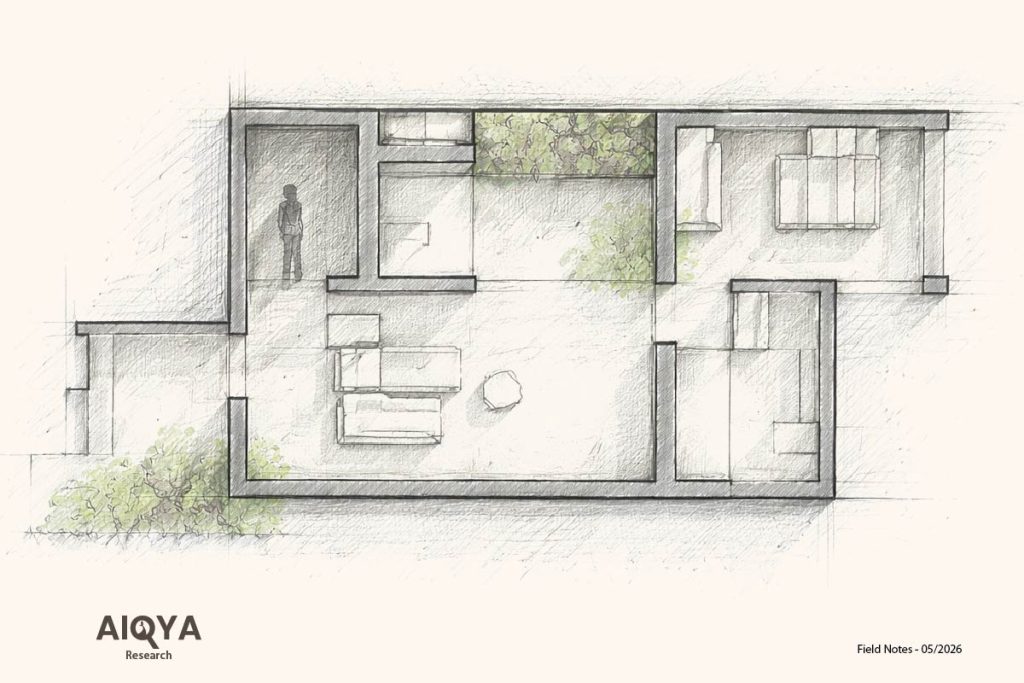
Architectural privacy works through spatial sequencing. Distances soften sightlines. Offsets break direct views. Changes in level, material, or light signal transition. These moves do not deny access. They delay it. In that delay, comfort is created.
Culturally, many traditional environments understood this instinctively. Homes were arranged to filter entry rather than block it. Visitors moved through layers before arriving. Daily life unfolded in semi visible spaces where presence did not imply invitation. Privacy was maintained not by exclusion, but by choreography.
Modern housing often collapses these layers. Open plans remove thresholds. Corridors deliver visitors directly into living spaces. Glass is used generously without mediation. What is gained in visual openness is often lost in psychological ease. The space may be bright and efficient, yet constantly alert.
Privacy without walls is not about exposure. It is about calibration. When architecture allows occupants to choose how much of themselves they reveal, privacy stops being defensive. It becomes supportive.
The Decode
Privacy without walls is created through arrangement rather than obstruction. It depends on how spaces relate to one another, not how firmly they are sealed. The eye, the ear, and the body read these relationships constantly, often before conscious thought intervenes.
Sightlines are the first filter. When a room opens directly onto another without offset, exposure is immediate. A slight shift in alignment changes this entirely. Angled entries, staggered walls, or indirect approaches allow a space to be visible without being readable. One can sense activity without being drawn into it. The space remains aware, not alert.
Distance performs a similar role. A few extra steps between a doorway and a seating area soften intrusion. The body registers the time it takes to arrive. This delay creates psychological permission, allowing occupants to remain settled rather than reactive. Privacy, here, is measured in metres rather than materials.
Sound is filtered through mass and texture rather than isolation alone. Complete acoustic separation is rarely necessary in domestic settings. What people seek instead is acoustic ambiguity. The ability to hear presence without deciphering content. Courtyards, verandahs, layered corridors, and changes in ceiling height absorb and diffuse sound, reducing sharpness without enforcing silence.
Light also contributes to privacy in subtle ways. Backlighting can silhouette movement without revealing detail. Lower light levels near thresholds discourage direct visual engagement. Brighter zones draw activity outward, while quieter edges recede. These gradients guide behaviour without instruction.
Thresholds are where these elements converge. A threshold is not merely a doorway. It is a zone where pace changes. Floors step up or down slightly. Ceilings lower. Materials shift underfoot. These cues signal transition without explanation. The body adjusts instinctively, understanding that one mode of behaviour is giving way to another.
Importantly, privacy without walls relies on repetition and consistency. When spatial cues are predictable, occupants relax. They know where visibility increases and where it softens. When layouts are inconsistent or overly open, the body remains vigilant, scanning constantly for exposure. Comfort erodes not because people are seen, but because they do not know when they might be.
Well designed privacy is therefore not about concealment. It is about legibility. Spaces communicate what they expect without enforcing it. When architecture provides these cues clearly, walls become less necessary. Privacy emerges through understanding rather than defence.
The Context
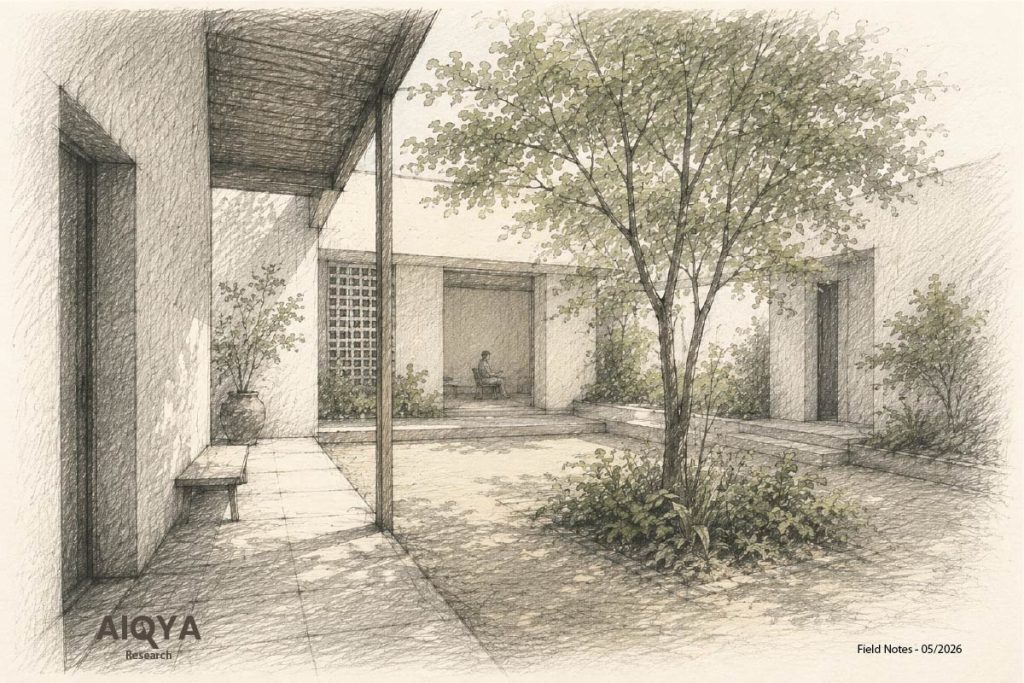
Across cultures, privacy has rarely been achieved through isolation alone. In many traditional housing patterns, the private realm was protected not by distance from others, but by the careful management of proximity. Homes opened inward. Streets led to thresholds, thresholds to shared spaces, and shared spaces to more intimate zones. Movement was gradual, and privacy accumulated rather than switched on.
In dense settlements, this layering allowed life to remain visible without becoming intrusive. Daily activities unfolded in semi open spaces where presence did not demand participation. One could observe, pass through, or withdraw without explanation. The environment supported a range of social distances simultaneously, adapting to mood and moment.
Contemporary housing often struggles to recreate this balance. As layouts prioritise efficiency and visual openness, transitional zones are compressed or removed. Living spaces are placed directly adjacent to entrances. Balconies are exposed without buffering. Internal corridors function purely as circulation, offering no pause or modulation. What results is not transparency, but fatigue. Occupants become hyper aware of being seen or heard, even when alone.
Where modern design succeeds, it does so by reintroducing layers without reverting to enclosure. Screens soften views without blocking light. Plan offsets break direct alignment. Shared spaces are positioned to allow passing without confrontation. These moves are subtle, but their impact is lasting. Privacy becomes something that can be adjusted rather than enforced.
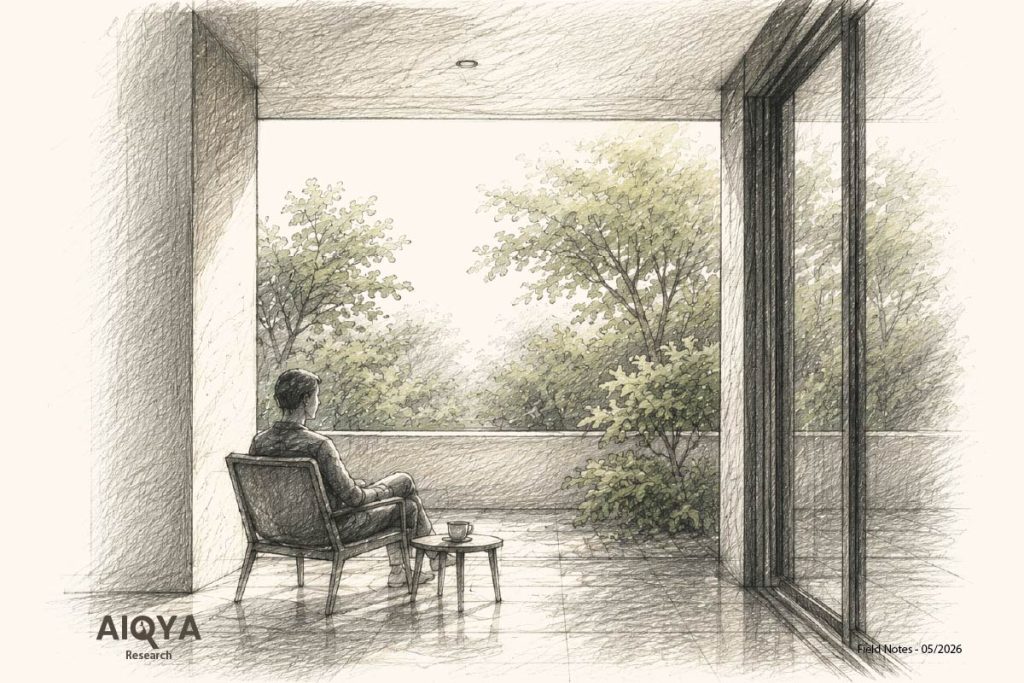
What emerges is a different understanding of comfort. Privacy is no longer tied to retreat. It is tied to choice. The ability to engage or disengage without explanation, to remain connected without exposure. In such environments, people feel secure not because they are hidden, but because they are in control of how they are perceived.
Privacy does not begin at the wall.
It begins where space allows us to choose how present we wish to be.
You may also like:
The Architecture of Pause: Designing Space for Stillness
Light, Air, and the Architecture of Ease