
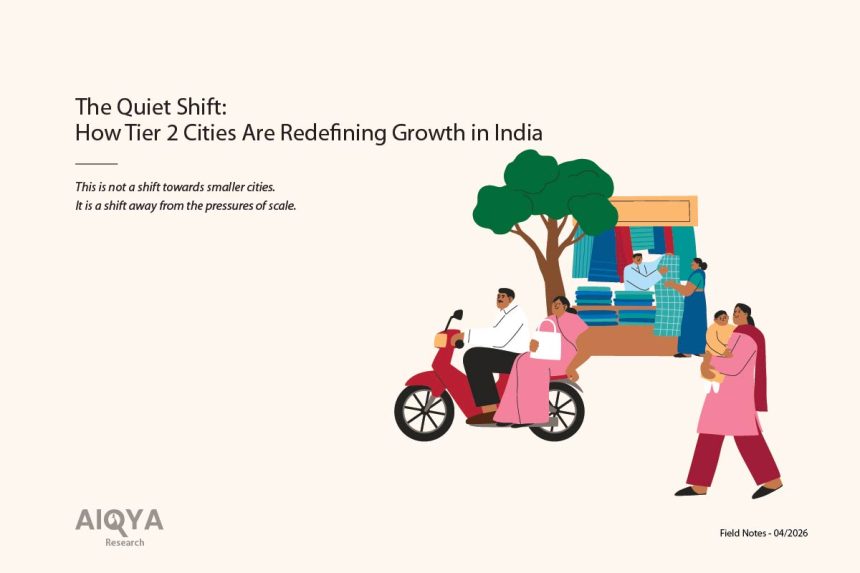
Tier 2 cities in India are quietly reshaping the country’s growth story. While larger metros continue to expand, a different shift is taking place beneath the surface. Cities like Mangalore, Coimbatore, Kochi and Indore are emerging not as alternatives to scale, but as anchors of stability, where growth is measured, retention is stronger and systems are able to hold.
This is not a shift towards smaller cities. It is a shift away from the pressures of scale.
There was a time when India’s growth story could be traced through a handful of cities. Bengaluru, Hyderabad and Pune expanded steadily, drawing in talent, capital and ambition. For nearly two decades, scale was the objective. More offices, faster hiring, continuous expansion. It was a model that delivered results.
But scale, when pushed far enough, begins to strain the very systems that support it. Commutes stretch, costs rise, and talent circulates faster than it settles. What once created efficiency begins to reduce it. The shift we are beginning to see today does not come from disruption. It comes from fatigue.
Within boardrooms, particularly across Global Capability Centres, a different question is taking shape. What if growth did not have to come at the cost of stability? The answers are not emerging from new megacities. They are being tested in places that have remained just outside the primary narrative.
Cities like Mangalore, Coimbatore, Kochi and Indore are beginning to draw attention. Not because they match the scale of the metros, but because they offer something increasingly difficult to find. Balance. Growth that does not overwhelm. Employment that does not churn. A pace that allows systems to hold.
This is not yet visible in skylines or headline numbers. It is visible in intent. And like most structural shifts, it is unfolding quietly.
The Shift
The movement towards Tier 2 cities in India is not driven by ambition alone. It is being shaped by constraints. Over the past few years, the cost of operating in established hubs like Bengaluru and Hyderabad has risen steadily, but cost is only part of the story. What concerns companies more today is unpredictability. Hiring cycles have become volatile. Attrition in some GCC roles continues to remain high, often forcing teams into a continuous loop of recruitment and training. In several Tier 1 markets, attrition in GCC and IT roles can exceed 25% annually, turning hiring into a continuous cycle rather than a defined phase.
The advantage is no longer just cost. It is the ability to build teams that stay.
This is where Tier 2 cities begin to present a different equation. The advantage is not simply lower salaries or cheaper office space. It is the ability to build teams that stay. In cities like Mangalore and Coimbatore, employee movement is slower and often more deliberate. Professionals are less likely to switch roles every year, partly due to fewer competing employers and partly due to a stronger connection to place. For companies, this translates into continuity.
The economics of this shift are subtle but significant. A slightly lower salary combined with longer employee tenure often results in a more efficient cost structure over time. Training investments hold their value. Team cohesion improves. Operational planning becomes more stable. These gains are not immediate, but they compound over time.
Lifestyle plays a role that is often underestimated in corporate decision-making. Shorter commutes, lower congestion and a less compressed urban experience contribute directly to employee retention. In cities like Kochi and Indore, the daily friction of living is lower. That ease has an impact on how long people choose to stay, and how consistently they perform.
What emerges from this is not a replacement for Tier 1 cities, but a rebalancing. Companies are no longer asking where they can scale the fastest. They are asking where they can operate with greater certainty. Tier 2 cities are beginning to answer that question.
This movement is no longer limited to early experimentation. Firms across sectors have begun to test these markets more deliberately. Companies such as Cognizant and Infosys have expanded their presence in cities like Coimbatore, while TCS and Wipro continue to explore distributed delivery models beyond the primary metros. In Kochi, global firms operating through Infopark and SmartCity have steadily increased their footprint, signalling a shift that is gradual but consistent.
Four Cities, Four Archetypes
Not all Tier 2 cities in India are evolving in the same way. To view them as a single category is to miss the nuance that is beginning to define this shift. Each city is taking on a different role within this emerging structure, shaped as much by its history as by its current trajectory.
Mangalore is, in many ways, a retention market. Its strength lies in consistency rather than scale. With institutions like National Institute of Technology Karnataka and the wider Manipal ecosystem feeding into its talent base, the city produces a steady stream of skilled graduates. What makes it distinct is not just supply, but behaviour. A large part of the workforce is locally anchored, which reduces churn and creates an environment suited for stable, long-term operations. It is not a city built for rapid expansion, but for continuity.
Coimbatore presents a different model. It carries the legacy of an industrial economy while gradually building a technology layer on top of it. The presence of small and medium enterprises, particularly in manufacturing and textiles, has created a culture of entrepreneurship and self-sufficiency. As IT and services firms expand here, they enter a system that already understands business cycles. This makes Coimbatore less dependent on external momentum and more capable of sustaining its own growth.
Kochi operates as a gateway. Its evolution has been closely tied to its global connections, both through trade and through a strong non-resident Indian network. Developments such as Infopark and SmartCity have attracted a mix of global and domestic firms, including IBM and EY, giving the city a service-oriented ecosystem with international linkages. Unlike purely domestic markets, Kochi benefits from capital and demand that flows in from outside the country, giving it a slightly different rhythm compared to other Tier 2 cities.
Indore is perhaps the closest among the four to a scale story. Backed by consistent improvements in infrastructure and governance, the city has begun to attract larger investments in technology and services. Its central location adds to its appeal, making it accessible from multiple regions. While it does not yet match the depth of larger metros, it shows the early signs of a city that can expand without immediately encountering the constraints seen elsewhere.
Taken together, these cities do not represent a uniform trend. They represent a spectrum. Retention, self-sustained growth, global connectivity and emerging scale. Understanding this distinction is critical, because the opportunity in Tier 2 India does not lie in replication. It lies in alignment.
What This Means for Real Estate
The shift towards Tier 2 cities in India is not immediately visible in price charts. It appears first in the nature of demand. Unlike larger metros, where speculative buying often precedes actual occupancy, these markets tend to move with end users. Homes are purchased to be lived in, not positioned for exit.
In cities like Coimbatore and Indore, this creates a more grounded pricing environment. Appreciation exists, but it is rarely abrupt. Instead of sharp spikes driven by investor sentiment, price movement tends to follow employment growth and income stability. This results in a market that feels slower, but also more resilient.
In these markets, value is not driven by acceleration, but by alignment.
Mangalore and Kochi offer another layer to this dynamic. Here, lifestyle plays a more visible role in shaping demand. Coastal geography, lower density and a relatively calmer urban fabric influence how projects are designed and perceived. Residential developments often lean towards openness, ventilation and community spaces rather than maximising built-up efficiency at the cost of liveability.
From a financial perspective, this changes how value is measured. In larger cities, returns are often evaluated through price acceleration. In Tier 2 markets, the equation shifts towards stability of occupancy, rental consistency and long-term usability of the asset. The absence of extreme volatility reduces both upside and risk, creating a different kind of investment profile.
There is also a structural difference in supply. Large-scale, high-density developments are still limited in these cities. This keeps pressure on infrastructure relatively contained, but also means that sudden demand surges can create short-term supply gaps. Developers entering these markets often have to recalibrate their approach, balancing scale with context rather than replicating metro-driven models.
What emerges is not a high-growth real estate story in the conventional sense. It is a market where price, design and demand remain closely linked. And in a landscape increasingly shaped by volatility, that alignment begins to carry its own value.
The Constraint Beneath the Opportunity
For all the advantages that Tier 2 cities in India present, the limitations are just as important to understand. These are not markets that can absorb growth indefinitely. Their strength lies in stability, but that stability is closely tied to scale.
The talent pool, while reliable, is not deep enough to support rapid expansion. A company can build a team of a few hundred with relative ease in cities like Mangalore or Coimbatore, but moving beyond that often requires drawing talent from outside. At that point, the same challenges seen in larger cities begin to surface.
Ecosystems are still evolving. Compared to Bengaluru or Hyderabad, the availability of specialised vendors, service providers and support infrastructure remains limited. This does not prevent growth, but it does slow it down. Companies entering these markets need to build more of the ecosystem themselves rather than relying on what already exists.
Connectivity continues to be a practical constraint. While improvements are underway, especially in cities like Kochi and Indore, access is still not at par with major metros. For global teams, travel frequency and ease of movement play a role in location decisions, and this remains a consideration.
There is also a concentration risk that is often overlooked. In smaller markets, a limited number of large employers can disproportionately influence demand. If hiring slows down or a major employer exits, the impact is felt more immediately across both employment and real estate.
These constraints do not weaken the case for Tier 2 cities. They define it. The opportunity here is not about unchecked growth. It is about controlled expansion within a framework that can sustain itself.
AIQYA Insight
The idea that Tier 2 cities in India will replicate the trajectory of larger metros misses the point. These are not cities preparing to become the next Bengaluru or Hyderabad. Their value lies in offering an alternative to that model.
What is unfolding is a redistribution of intent. Scale is no longer the only marker of success. Stability, continuity and the ability to operate without constant disruption are beginning to carry equal weight. For companies, this changes how locations are selected. For real estate, it changes how value is understood.
Cities like Mangalore, Coimbatore, Kochi and Indore are not breakout markets in the traditional sense. They are balancing markets. Their role is not to accelerate the system, but to absorb its excesses.
This distinction matters. Because the future of urban growth in India may not be defined by how fast cities expand, but by how well they hold.
And in that equation, these cities are beginning to find their place.
You may also like: