
Courtyard Architecture: Climate, Culture and Social Life

Courtyard architecture is not architectural nostalgia. It is a spatial system that organises light, air, movement, and everyday life within homes and communities.

9 Min Read
Courtyard Architecture: Climate, Culture and Social Life

Courtyard Architecture appears across cultures that share little else in common. From Mediterranean towns to traditional Indian homes, the courtyard has long served as a mediator between climate, privacy, and everyday life. More than a decorative element, it is a spatial system that regulates light, airflow, and social interaction within the home.

Courtyards are not architectural nostalgia. They are social, climatic, and cultural instruments that organise everyday life.


A courtyard is rarely the largest space in a home.
Yet it is often the one around which life quietly gathers.

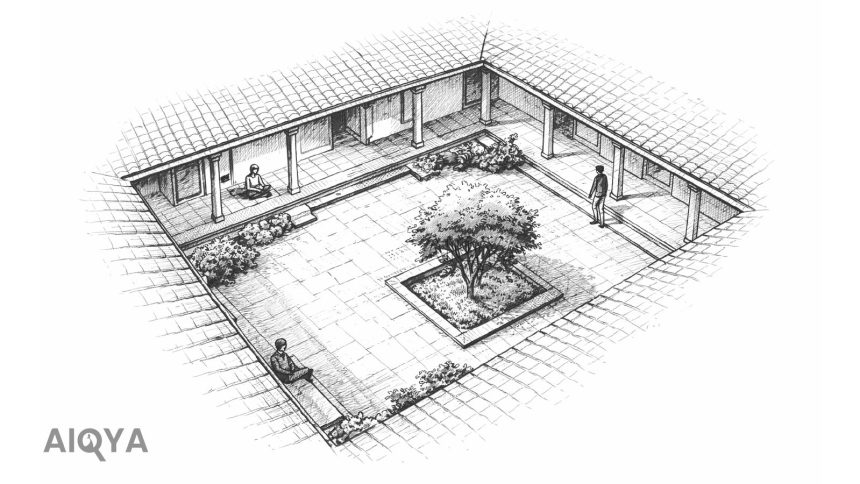
It holds neither furniture nor programme with certainty. At different times, it becomes a passage, a pause, a gathering place, or simply an opening to the sky. Children pass through it without instruction. Conversations slow near its edges. Light, rain, and sound enter the home through it before reaching anywhere else.

The courtyard does not announce its purpose.
It absorbs it.


The Idea

Courtyards appear across geographies that share little else in common. From Mediterranean towns to Indian homes, from Islamic architecture to East Asian compounds, the form recurs with quiet consistency. This persistence is not aesthetic coincidence. It signals a deep alignment between human behaviour, climate, and spatial organisation.

At its core, the courtyard is a mediator. It sits between inside and outside, between private and shared, between shelter and exposure. Unlike rooms that are defined by walls and furniture, the courtyard is defined by absence. It is open to the sky, yet enclosed by life around it. This ambiguity allows it to adapt continuously without being reassigned.

The courtyard survives not because it belongs to the past, but because it continues to make sense.

Culturally, courtyards organise daily rhythms. They accommodate work in the morning, rest in the afternoon, and gathering in the evening. They allow activities to overlap without conflict. One person can sit quietly while another passes through. A conversation can occur without enclosing itself. Life remains visible without becoming intrusive.

Climatically, courtyards regulate comfort through simple means. They draw light into dense interiors, release warm air upward, and temper extremes through shade and proportion. Rather than resisting the environment, they work with it, creating conditions that feel balanced rather than controlled.

What makes the courtyard enduring is this dual role. It supports both the physical needs of a building and the social needs of its inhabitants. It does not prescribe how it must be used. Instead, it creates the conditions for use to evolve naturally. In doing so, it becomes less a space to occupy and more a structure that holds relationships.

The courtyard survives not because it belongs to the past, but because it continues to make sense. It remains relevant wherever architecture seeks to support life rather than stage it.


The Decode

The courtyard works because it accepts contradiction. It is open yet contained, shared yet private, active yet still. Most architectural spaces attempt to resolve such tensions through separation. The courtyard holds them together.

From a spatial standpoint, it operates as a regulator. Rooms arranged around a courtyard gain orientation without exposure. Light enters indirectly, softening as it reflects off walls. Sound disperses upward rather than traveling laterally. Movement slows as circulation passes through a space that is neither corridor nor destination. The result is a house that breathes inward rather than opening itself indiscriminately outward.

Socially, the courtyard establishes a gentle hierarchy without enforcing it. Activities remain visible without demanding participation. One can observe without intruding, pass through without interrupting, and linger without explanation. This quality is rare in contemporary layouts, where spaces are often assigned a single function, and interactions are either staged or avoided. The courtyard allows coexistence without choreography.

Its environmental logic is equally precise. Proportion matters more than size. A courtyard that is too wide loses shade and thermal advantage. One that is too narrow restricts light and airflow. Traditional courtyards evolved within narrow dimensional ranges that balanced these forces intuitively. Warm air rises and escapes. Cooler air is drawn through lower openings. Rain is admitted deliberately, not excluded. The courtyard becomes a climatic moderator rather than a decorative void.

Importantly, courtyards distribute comfort across time rather than fixing it. Morning light enters gently. Midday heat is absorbed by the surrounding mass. Evenings cool quickly as stored heat dissipates upward. Comfort shifts, but it remains legible. The building does not attempt to maintain sameness. It allows variation, trusting occupants to adapt.

Modern interpretations often struggle because they imitate form without understanding function. Courtyards become oversized atriums or sealed light wells, stripped of their environmental role. When disconnected from proportion, material, and use, they lose their quiet authority. What remains is an empty gesture rather than a living space.

When understood correctly, the courtyard is not an architectural feature. It is a system that organises light, air, movement, and social life simultaneously. Its success lies in how little it insists upon itself. It works because it allows life to happen around it, not because it demands attention.


The Context

Courtyard Architecture: Climate, Culture and Social Life

Courtyards emerge most clearly in places where density, climate, and social life must coexist without friction. In tightly packed settlements, they create inward relief without retreat. Homes open toward a shared centre, allowing light and air to enter while maintaining discretion from the street. The result is a form of privacy that does not rely on isolation.

Courtyards offer a model of shared space that does not require constant management or explanation.

Across cultures, this logic adapts rather than repeats. In warmer regions, courtyards are compact and shaded, tuned to reduce glare and release heat. In temperate climates, they expand, admitting more light and accommodating seasonal change. Materials shift, proportions adjust, but the underlying role remains consistent. The courtyard mediates between exposure and shelter, between collective life and personal space.

What is notable is how rarely courtyards are designed as singular moments. They tend to belong to clusters, neighbourhoods, and extended families rather than individual statements. Their value increases through repetition. A sequence of courtyards creates a rhythm of openness and enclosure that structures daily movement and social encounter. Life unfolds gradually rather than being concentrated in one formal space.

Contemporary housing often struggles to replicate this condition. As buildings grow taller and footprints tighten, shared space is pushed to podiums, terraces, or enclosed atriums. These spaces are usually programmed, labelled, and timed. The courtyard, by contrast, resists instruction. It remains usable precisely because it is undefined.

Where modern developments succeed with courtyards, they do so by respecting this restraint. Open-to-sky spaces remain permeable to weather. Edges are designed for sitting rather than spectacle. Planting is allowed to mature slowly. These courtyards do not attempt to perform. They simply remain available.

In this availability lies their enduring relevance. Courtyards offer a model of shared space that does not require constant management or explanation. They support everyday life quietly, holding space for interaction without prescribing it.


The Reflection

The courtyard endures because it does not compete for attention.
It offers space without instruction, and in doing so, allows culture, climate, and everyday life to meet on their own terms.

Share This Article
Leave a Comment