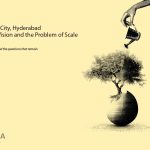
Musi River redevelopment Hyderabad is positioned as a large-scale effort to restore a 55 km urban corridor. But beyond the vision, the project raises deeper questions about sequencing, infrastructure depth, and long-term continuity.
Part of the AIQYA Field Notes series on Hyderabad’s Future City – examining land, infrastructure, and the systems shaping its long-term viability.
A city can neglect a river for decades and still speak of it sentimentally. Restoring it is harder. That requires not memory, but systems.
Hyderabad’s Musi Redevelopment project arrives with the scale and language of a once-in-a-generation intervention. Officially, it is framed as the rejuvenation of the Musi’s 55 km corridor and its transformation into a new urban spine for the city. The public vision is expansive: sewage interception, treatment infrastructure, floodplain management, ecological restoration, promenades, bridges, blue-green zones, and new public life along the riverfront.
On paper, that ambition is easy to understand. The Musi is too central to Hyderabad, and too degraded, to be treated as a residual water channel indefinitely. A river carrying heavy pollution loads, fragmented edges and decades of institutional neglect cannot remain outside the city’s planning imagination forever.
But this is precisely where the project becomes more complex than its renderings.
Because Musi is not simply a riverfront project. Nor is it purely an ecological one. It is an attempt to do three difficult things at once: repair a polluted river, build flood and sewage infrastructure at scale, and reimagine the land around the river as part of Hyderabad’s next urban chapter. The official project material itself makes that clear. Alongside water management and ecological restoration, the vision also speaks the language of mixed-use nodes, transit-oriented development, connectivity and economic activation.
That duality is where the project derives both its promise and its risk.
A river restoration project asks whether the water can be cleaned, whether sewage can be intercepted, whether floodplains can be respected, and whether ecology can return. A redevelopment project asks how the edge can be used, connected, valued and made visible. These are related ambitions, but they do not always move in the same order, In practice, they often move in opposite directions and they do not always serve the same priorities.
So the Musi question is not whether Hyderabad should act. It should. The sharper question is whether the city is beginning with the river itself, or with the possibilities that open up around it once the river is declared available for reinvention.
That distinction matters. Because if the sequence is wrong, what appears to be rejuvenation can quietly become something else.
What the Project Officially Is
At its core, the Musi Redevelopment project is positioned as a corridor-scale intervention rather than a single-site project. The official scope spans approximately 55 kilometres of the river within and around Hyderabad, covering both the main Musi stretch and its associated tributaries and catchment influences.
The mandate, as outlined by the Musi Riverfront Development Corporation, is broad. It includes:
- sewage interception and diversion systems
- expansion and upgrading of sewage treatment capacity
- stormwater management and trunk infrastructure
- flood mitigation through channel profiling and embankment strategies
- ecological restoration of the river edge
- development of public spaces, promenades and access corridors
At this level, the project reads as a multi-layered urban infrastructure programme, not just a riverfront upgrade.
But the official vision does not stop at environmental repair. It extends into urban transformation.
Planning documents and presentations indicate that the corridor is also being treated as a development spine, with provisions for:
- new road networks and improved connectivity along the river
- bridges and cross-river linkages
- mixed-use development zones
- transit-oriented nodes
- integration with larger city mobility plans
This expands the project from being a water management initiative into a city-shaping framework.
The institutional structure reflects this scale. The project is being handled through a dedicated entity, with involvement across departments including urban development, irrigation, municipal administration and infrastructure planning. This multi-agency approach is necessary given the overlap between hydrology, urban form and land use.
Phase I of the project, as publicly presented, focuses on a priority stretch of roughly 20–21 kilometres. This phase includes core interventions such as:
- river cleaning and desilting
- slope stabilisation and embankment works
- construction of trunk sewer lines and pumping systems
- additional sewage treatment capacity
- new bridges and access infrastructure
- initial public realm and riverfront development components
The scale and sequencing of Phase I are important. It sets the tone for how the rest of the corridor will evolve. Whether the early phases prioritise invisible systems or visible transformation will influence how the project is perceived and how it unfolds.
Taken together, the Musi Redevelopment project is not a single intervention. It is an attempt to align water systems, urban infrastructure and land use within a continuous corridor.
That ambition is significant.
But it also means that the project has to succeed across multiple layers simultaneously.
The Dual Ambition: River Repair and Riverfront Development
The Musi project is structured around two parallel ideas. One is technical and necessary. The other is spatial and aspirational.
The first is river repair. It deals with what the Musi currently is. A river carrying untreated and partially treated sewage, shaped by altered flows, encroachments and a stressed catchment. Addressing this requires systems that are largely invisible: interception networks, treatment capacity, stormwater separation, floodplain management and long-term ecological recovery.
The second is riverfront development. It deals with what the Musi could become. A continuous public edge, better connected across the city, activated through access, movement, and built form. This is where the project becomes visible. Promenades, bridges, landscaping, access roads and development nodes begin to define how the river is experienced.
Individually, both directions are valid. Together, they introduce a question of sequence.
River repair is slow, cumulative and dependent on systems working consistently over time. It requires upstream discipline, coordination across agencies and sustained investment in infrastructure that does not immediately translate into visible change.
Riverfront development moves differently. It produces early, tangible outcomes. Public spaces can be built, edges can be formalised, and connectivity can be improved within shorter time frames. These interventions are easier to communicate and easier to measure in the short term.
The tension between the two is not theoretical. It is structural.
If river repair leads, development can follow on a stable base. Water quality improves, flood behaviour becomes more predictable, and the ecological condition of the river begins to recover. The edge then reflects a system that is already functioning.
If development leads, the edge can change before the river does. In that scenario, the project risks creating a controlled visual environment around a system that remains unresolved beneath it.
This is not a question of intent. It is a question of alignment.
The Musi project, as currently framed, holds both ambitions together. Whether it can maintain the right sequence between them will determine what the river ultimately becomes.
A river restoration project asks what the water can become. A riverfront project asks what the edge can become.
Sewage, Hydrology, and Infrastructure Depth
At its most basic level, the condition of the Musi is not a design problem. It is an infrastructure problem.
The river today functions as a carrier of wastewater because a significant portion of the city’s sewage either does not reach treatment systems or reaches them only partially. Interception and diversion along the river edge are part of the proposed solution, along with additional treatment capacity and trunk sewer networks.
These are necessary interventions. But they are not sufficient on their own.
Sewage systems operate as networks. What reaches the river is the outcome of what happens upstream across thousands of connections, formal and informal. In areas where sewer connectivity is incomplete, wastewater finds its way into natural drains and eventually into the river. Strengthening infrastructure only at the edge does not fully address that pattern.
This is where the depth of the intervention becomes critical. For the river to change, the system feeding into it has to change as well. That includes expanding sewer networks into underserved areas, ensuring that treatment plants operate at capacity, and maintaining those systems over time.
There is also the question of what exactly is being treated. Domestic sewage and industrial effluents behave differently and require different forms of control. Treatment plants can process volume, but they do not substitute for regulation. Without consistent monitoring and enforcement upstream, the burden shifts to downstream infrastructure.
Hydrology adds another layer of complexity. The Musi is no longer a river defined purely by natural flow. Its behaviour is shaped by upstream reservoirs, urban runoff and seasonal variability. Flood mitigation measures such as channel profiling and embankments are part of the project, but these have to respond to real flow conditions rather than assumed ones.
If hydraulic logic is respected, it can reduce flood risk and stabilise the river corridor. If it is overridden by edge development or constrained sections, the river may behave unpredictably during peak events.
This is where infrastructure becomes more than engineering. It becomes a question of whether systems are allowed to function as systems. Because the river reflects the system it is connected to, not the edge that is built around it.
Because the success of the Musi project will not be visible first in its promenades or bridges. It will be visible in the quality of its water, the consistency of its flows and the reliability of the networks that support it.
Phase I and What It Signals
Large projects are often understood through their first phase. Not because Phase I completes the vision, but because it reveals priorities.
The initial rollout of the Musi project focuses on a defined stretch of roughly 20–21 kilometres within the broader corridor. The scope, as presented, combines river cleaning, desilting, embankment works, trunk sewer infrastructure, additional treatment capacity, new bridges and access roads, along with early public realm elements along the river edge.
On paper, this appears comprehensive. It touches both the river and the edge.
But the significance of Phase I lies in how these elements are sequenced and delivered.
If the early phase is anchored in sewage interception, treatment capacity and hydraulic stabilisation, it sets a foundation for the rest of the corridor. The river begins to change in measurable ways. Water quality improves, inflows are controlled and flood behaviour becomes more predictable. Development that follows is then built on a system that is already functioning.
If, however, visible interventions move faster than underlying systems, a different signal emerges. Riverfront edges take shape, access improves, and public perception shifts, but the condition of the river itself may lag behind. In such a scenario, Phase I establishes a visual baseline without fully resolving the system beneath it.
There is also a question of continuity within the phase itself. Infrastructure networks such as trunk sewers and pumping systems depend on completion across segments. Partial delivery can limit their effectiveness. Similarly, treatment capacity needs to align with actual inflows, not projected ones.
Phase I, therefore, is not just an initial step. It is a test of alignment.
It indicates whether the project is being driven by the logic of systems or by the logic of visibility. And that distinction will shape how the remaining corridor unfolds.
People, Land and the River Edge
Any intervention of this scale inevitably intersects with existing settlements. The Musi corridor is not an empty edge waiting to be redesigned. It is already occupied, layered with informal housing, small economies, religious structures and long-standing social networks.
The project formally acknowledges this. Public statements indicate that thousands of families currently live along or near the proposed intervention zones, with plans for relocation and housing provision as part of the process.
The challenge, however, is not in recognition. It is in resolution.
Relocation is often presented as a logistical step, but in practice it is a structural shift in people’s lives. Distance from workplaces, access to schools, continuity of community networks and the availability of services all determine whether relocation leads to stability or disruption.
If rehabilitation is near-site, connected to existing livelihoods and supported by infrastructure, it can function as transition. If it is distant, fragmented or delayed, it becomes displacement.
There is also a spatial dimension to this question. Riverfront development increases the value of adjacent land. As infrastructure improves and access expands, the edge becomes more attractive for formal development. This creates pressure to reorganise land use along the corridor.
In that context, the sequence of intervention matters again. If rehabilitation is completed before land values begin to shift, it can be integrated into the project. If not, the process becomes reactive, shaped by market pressures rather than planning intent.
The Musi project, therefore, is not only about water and infrastructure. It is also about how the city negotiates space.
Because the river edge is not just a physical boundary. It is a social one.
Governance, Time and the Problem of Continuity
Projects of this scale do not unfold within a single planning cycle. They extend across years, often across administrations, and through changing economic priorities. This is where the Musi project moves from design into governance.
The corridor itself has already moved through multiple narratives. At different points, it has been framed as an industrial extension, a pharmaceutical cluster and now as a broader urban redevelopment spine. Each shift reflects a response to a particular moment, but it also introduces a degree of discontinuity.
Infrastructure systems, particularly those tied to water and waste, operate differently. They depend on consistency. Once established, they require sustained funding, coordinated execution and ongoing maintenance. They do not reset easily when priorities change.
This creates a structural tension. Urban projects can adapt to new narratives, but infrastructure systems need stability to perform.
There is also the question of institutional alignment. The Musi project involves multiple agencies, each with its own mandate, timelines and operational frameworks. Coordination is not a one-time requirement. It has to be maintained throughout execution and beyond.
Market dynamics add another layer. Development along the corridor will not progress uniformly. Some segments will advance faster than others, influenced by access, land ownership patterns and investor interest. For a system that depends on continuity along its length, uneven progress introduces operational challenges.
Governance, in this context, is not only about approvals or announcements. It is about the ability to sustain a direction.
Because the Musi project will not succeed or fail at the point of launch. It will be shaped over time, by how consistently its underlying logic is carried forward.
The success of the Musi will not be visible first in its promenades, but in the condition of its water.”
AIQYA Insight
The Musi project is not difficult because the problem is unclear. The problem is well understood. A polluted river, fragmented infrastructure and an underutilised urban corridor.
What makes it difficult is the attempt to solve multiple layers at once.
River repair requires patience. It depends on systems that work quietly over time. Sewage networks, treatment capacity, flood management and ecological recovery do not produce immediate visual outcomes. They accumulate.
Urban development moves differently. It responds to visibility, access and land value. It creates early signals. It shapes perception.
The Musi project sits at the intersection of these two timelines.
If infrastructure leads and development follows, the river can begin to function again as a system. Water quality improves, flows stabilise and the corridor gains meaning beyond its edges.
If development leads, the river risks becoming a backdrop. The edge transforms, but the system beneath it remains partially unresolved.
That distinction will not be decided in plans or presentations. It will be decided in sequence.
Because the question is not whether the Musi can be redesigned. The question is whether the Musi can be rebuilt as a system before it is claimed as a place.
Part of the Future City Series:
- Land, Scale, and the Limits of Planning
- Musi Redevelopment and the Question of Continuity
- Infrastructure at Scale: Beyond District Cooling
This article is based on publicly available information and evolving proposals related to Hyderabad’s Future City. Interpretations reflect a research-led perspective and may change as plans progress and execution unfolds.